
India Co-living Report 2026: Rising Rents, GCC Growth, and the Race Into Tier 2 and Tier 3 Cities
TL;DR: This India Co-living Report 2026 tracks how rising rents, GCC growth, and fresh institutional capital are pulling organized co-living operators into 12 Tier 2 and Tier 3 Indian cities, even as the sector’s own numbers show 95 percent of the market remains untapped.
Jump to a section
- Key Numbers
- Executive Summary
- Market Overview
- Market Dynamics
- Market Segmentation
- Competitive Landscape
- Future Outlook
- Methodology and Sources
Key Numbers
- India’s total PG and co-living market, organized and unorganized combined, is worth approximately USD 6.3 billion, or Rs 52,300 crore. Organized, branded operators occupy only about 5 percent of it today.
- The organized segment itself is still growing fast, Rs 4,400 crore in 2025, projected to reach Rs 16,270 crore by 2031, a 24.34 percent CAGR.
- 208 companies tracked in the sector, Rs 5,040 crore in cumulative funding raised, zero unicorns.
- National rents rose 18.1 percent year on year in Q3 2025, moderating to 14 percent by Q1 2026.
- In Bengaluru, co-living runs Rs 11,000 to Rs 22,000 a month against Rs 14,500 to Rs 34,200 for a comparable one-bedroom apartment.
- 12 Tier 2 and Tier 3 cities have gained organized co-living operators since late 2025.
- Roughly Rs 2,000 crore in institutional capital has been committed by Bain Capital and HDFC Capital alone since September 2025.
- In InstaDwell’s own research, 61 out of 61 PG and co-living searchers refused to book without a physical visit first.
Executive Summary
Rents rose fast enough in 2025, and are still elevated enough in 2026, that renters are choosing co-living over traditional rentals on price alone. In Bengaluru, co-living is cheaper than a comparable one-bedroom apartment at every price point.
That gap is pulling organized operators into 12 Tier 2 and Tier 3 cities that had almost no branded co-living presence two years ago, backed by fresh institutional capital from Bain Capital and HDFC Capital.
But the sector’s own numbers complicate the growth story. Despite 208 tracked companies and Rs 5,040 crore in cumulative funding, India’s co-living sector has produced zero unicorns. Independent market sizing rates the sector’s concentration as low. Growth is real. Dominance is not, yet.
The bigger number is penetration, not funding. Organized operators capture only about 5 percent of the total PG and co-living market. This report tracks where that 95 percent sits, what is pulling operators toward it, and what is stopping them from closing the gap faster.
Market Overview
India’s total PG and co-living market, organized and unorganized combined, is worth approximately USD 6.3 billion, or roughly Rs 52,300 crore, according to Research and Markets. Organized, branded operators capture only about 5 percent of it. That gap, not the size of the branded segment alone, is what is drawing fresh institutional capital into the sector, investors are pricing in how much of the remaining 95 percent they can convert, not just how big the organized slice already is.
That estimate lines up closely with Colliers’ independent finding that organized co-living beds cover only about 5 percent of total demand. Two unrelated sources arriving at the same number is a useful cross check.
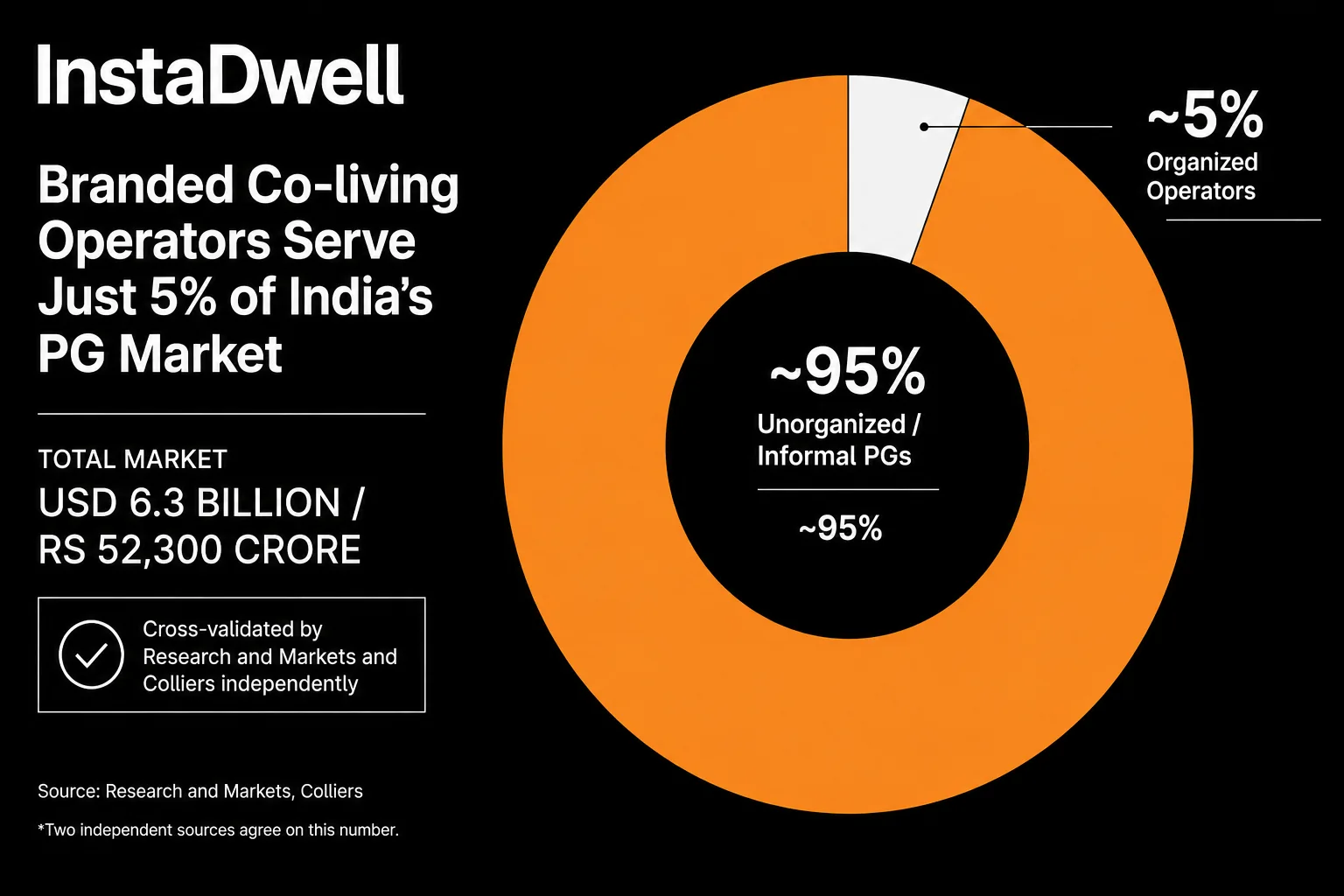
Branded co-living operators serve just 5 percent of India's PG market
The organized segment itself, though still small, is growing fast. Mordor Intelligence values it at approximately Rs 4,400 crore (USD 0.53 billion) in 2025, projecting growth to Rs 5,480 crore (USD 0.66 billion) in 2026 and Rs 16,270 crore (USD 1.96 billion) by 2031, a 24.34 percent compound annual growth rate.
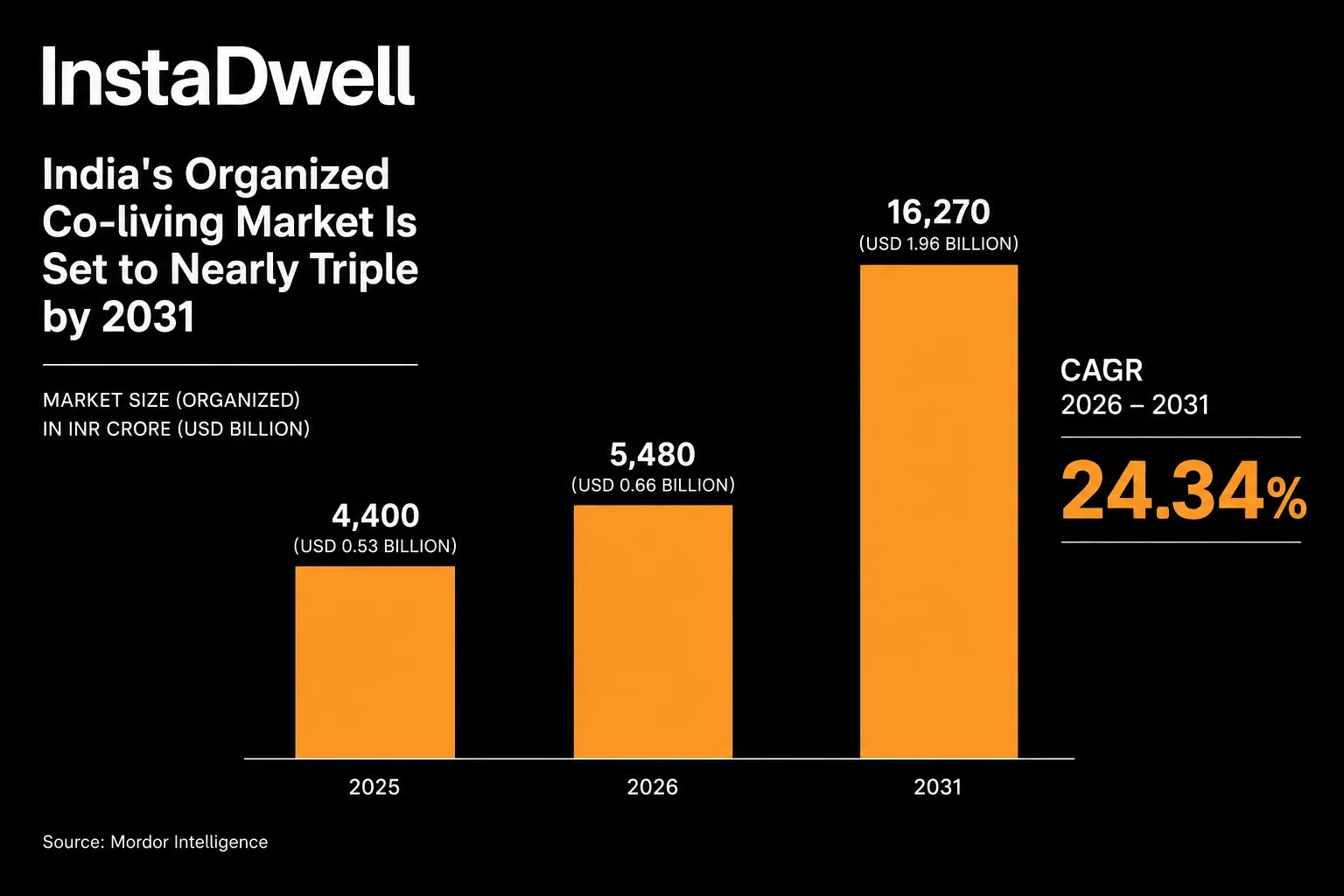
India's organized co-living market is set to nearly triple by 2031
The same analysis rates the market’s concentration as low. No single operator controls the space, even though a handful of brands, Stanza Living, Zolo, Housr, Colive and Settl, account for most of the public visibility and funding. The branded operators named throughout this report are competing for a small, fast growing share of a market that remains overwhelmingly unorganized.
Tracxn’s competitive tracking adds a second angle. It counts 208 companies in India’s co-living space, with Rs 5,040 crore in total equity funding raised cumulatively since these companies were founded, spanning roughly a decade in most cases. That is a cumulative capital figure, not an annual one, so it is not directly comparable to the single year market size above. It does show the sector has absorbed real institutional capital over time without producing a dominant winner, zero active unicorns as of 2026.
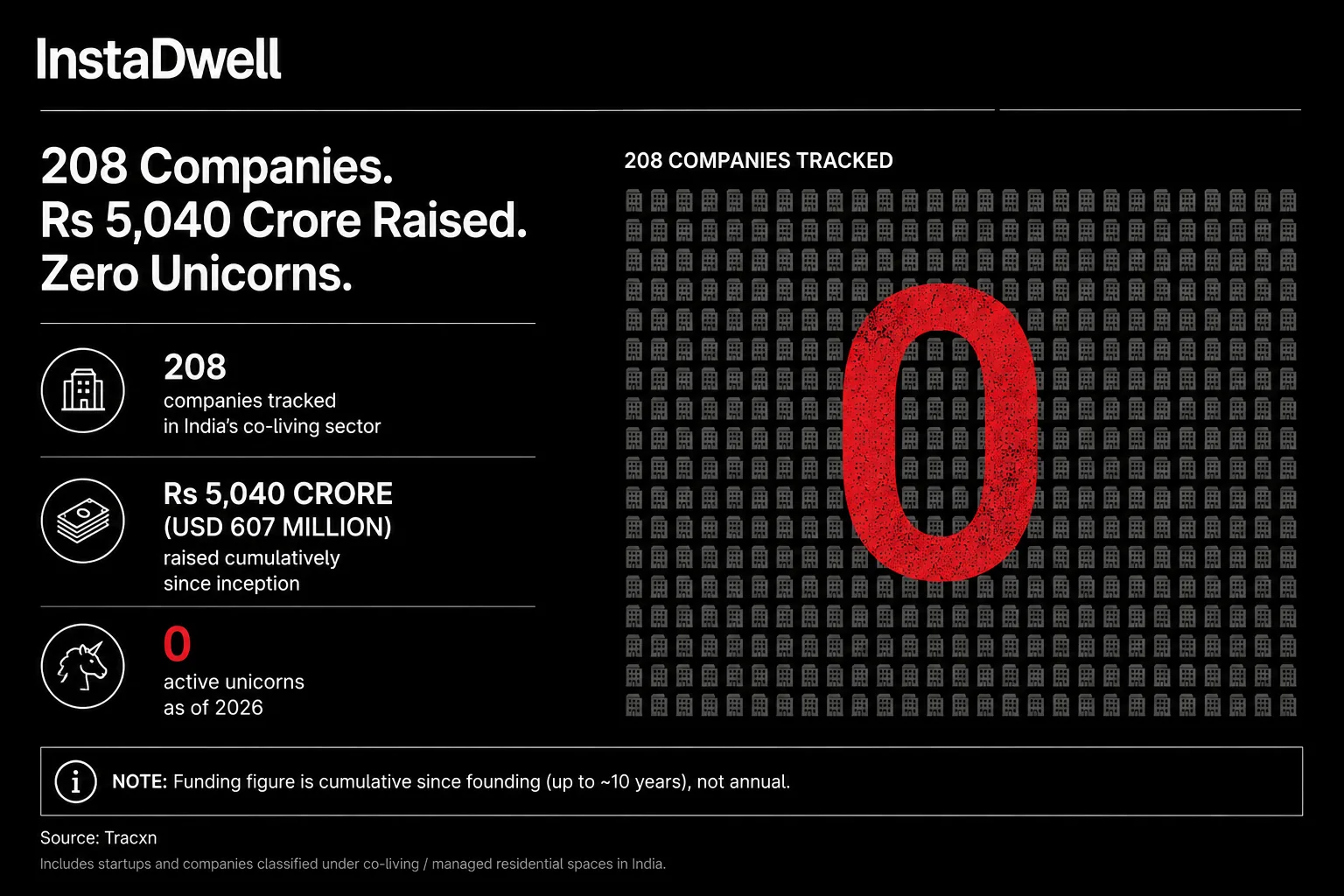
208 companies, Rs 5,040 crore raised, zero unicorns
Of the 36 new co-living startups founded between 2021 and 2026, only 5 launched in the last two years. New entrant formation is slowing even as the market’s value keeps rising. Call it India’s co-living unicorn desert, a sector with real revenue and real capital but, so far, no single dominant winner.
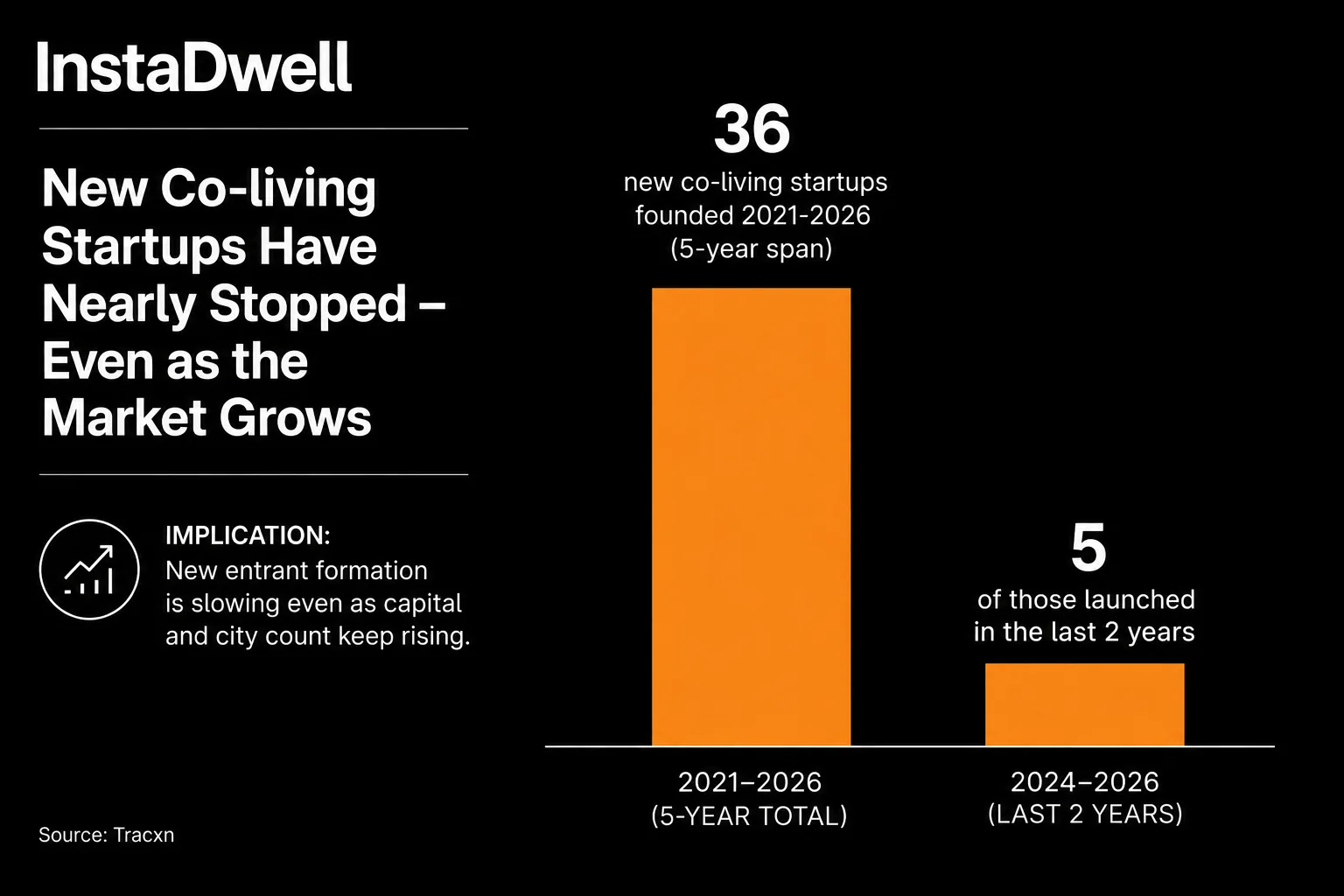
New co-living startups have nearly stopped even as the market grows
Market Dynamics
Drivers
Rent growth is outrunning demand, not following it. National rents rose 18.1 percent year on year as of Q3 2025, per the Magicbricks Rental Index, moderating to 14 percent by Q1 2026. National rental demand actually fell 2.1 percent year on year in that same Q1 2026 quarter. Rents climbed anyway. That is a supply and affordability mismatch, not a simple demand surge.
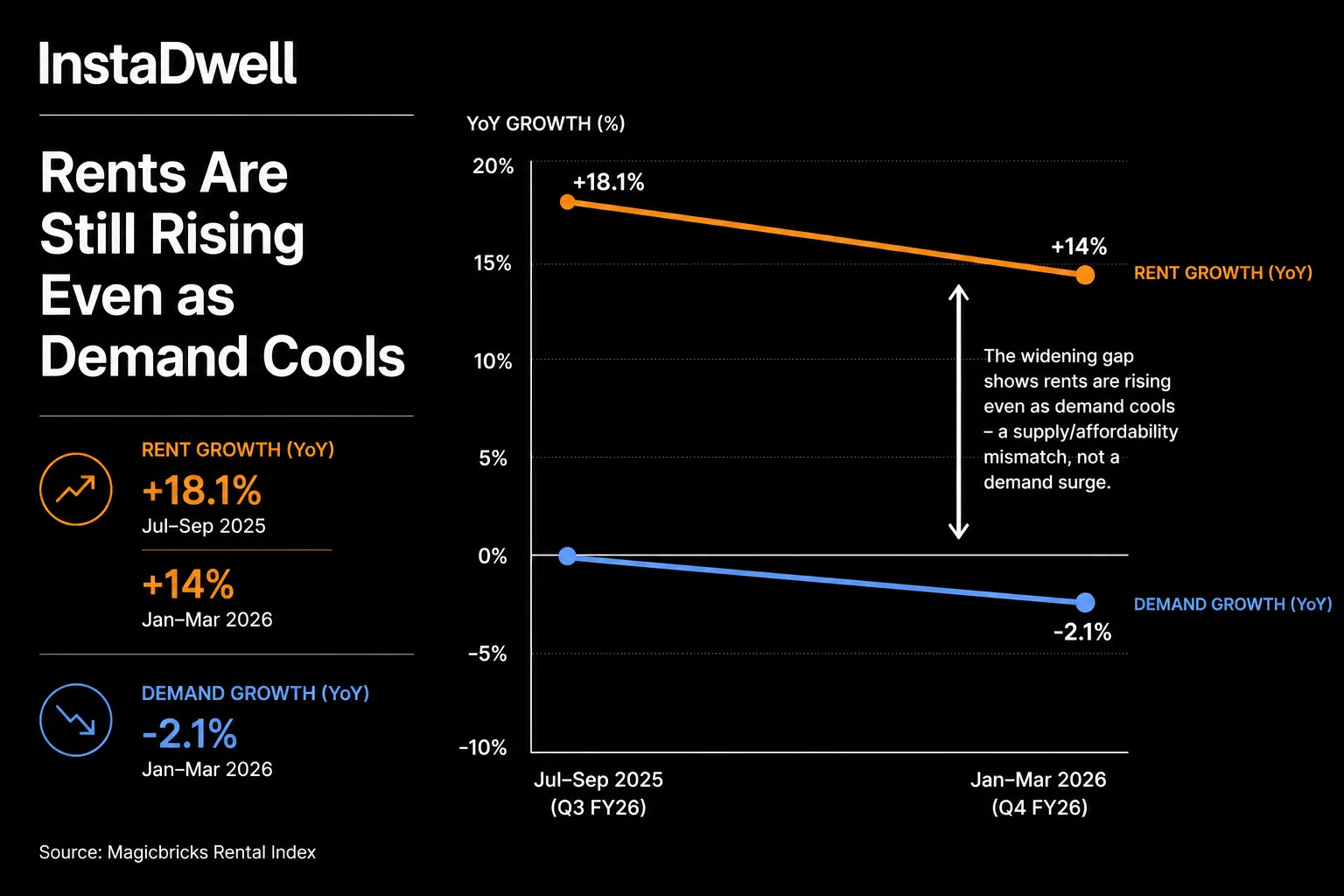
Rents are still rising even as rental demand cools
The budget data confirms it. National rental demand is concentrated in the Rs 10,000 to Rs 20,000 bracket, 36 percent of all demand, while available supply skews toward pricier brackets, 25 percent of inventory above Rs 50,000, 14 percent above Rs 1 lakh. Renters want affordable homes. What is available to rent increasingly is not. That is the gap co-living is built to fill.
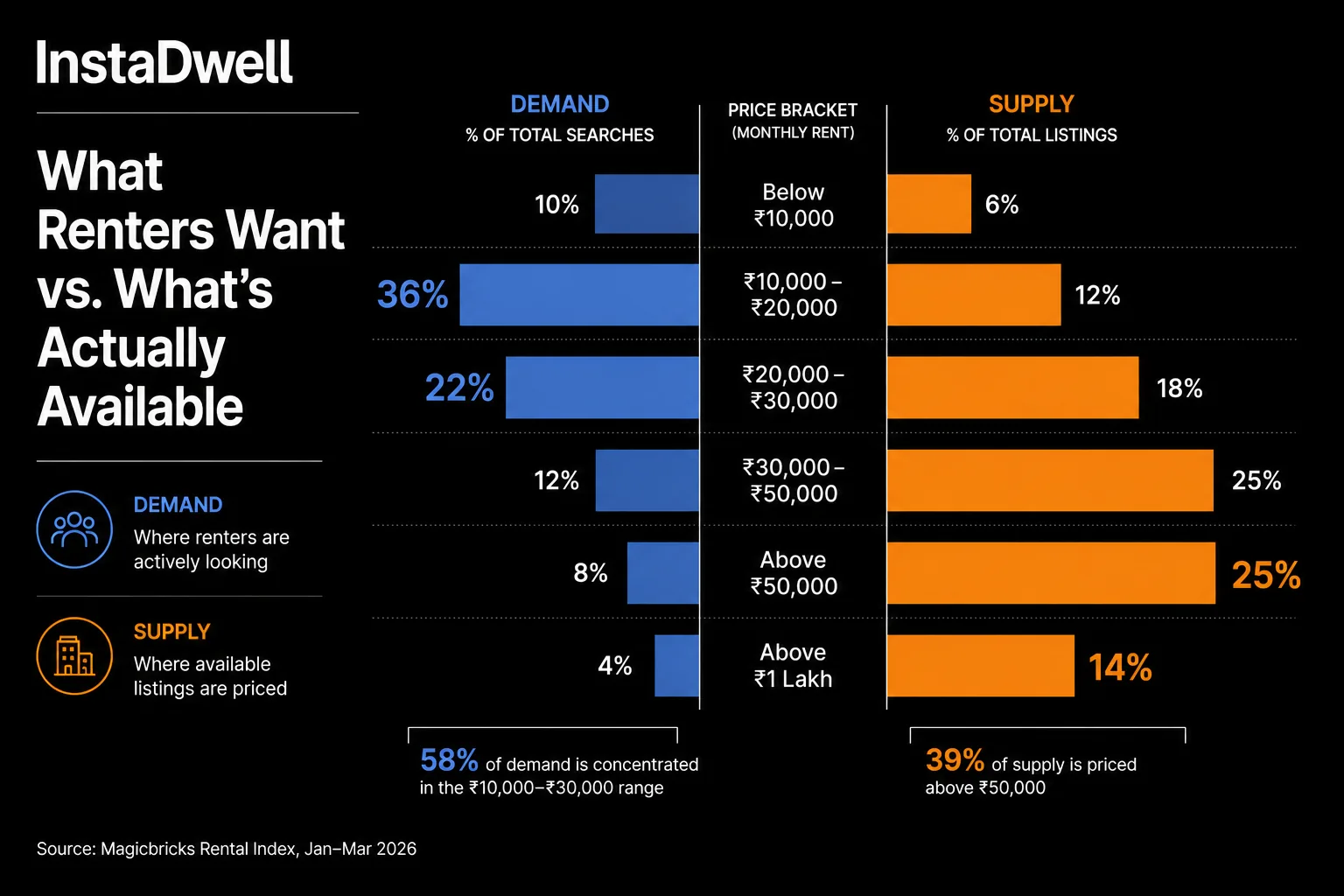
What renters want versus what is actually available
Bengaluru shows the clearest version of this. Co-living runs Rs 11,000 to Rs 22,000 a month there, against Rs 14,500 to Rs 34,200 for a comparable one-bedroom apartment. Co-living is cheaper at every comparable price point. It is functioning as an affordability escape hatch, not a lifestyle upgrade.
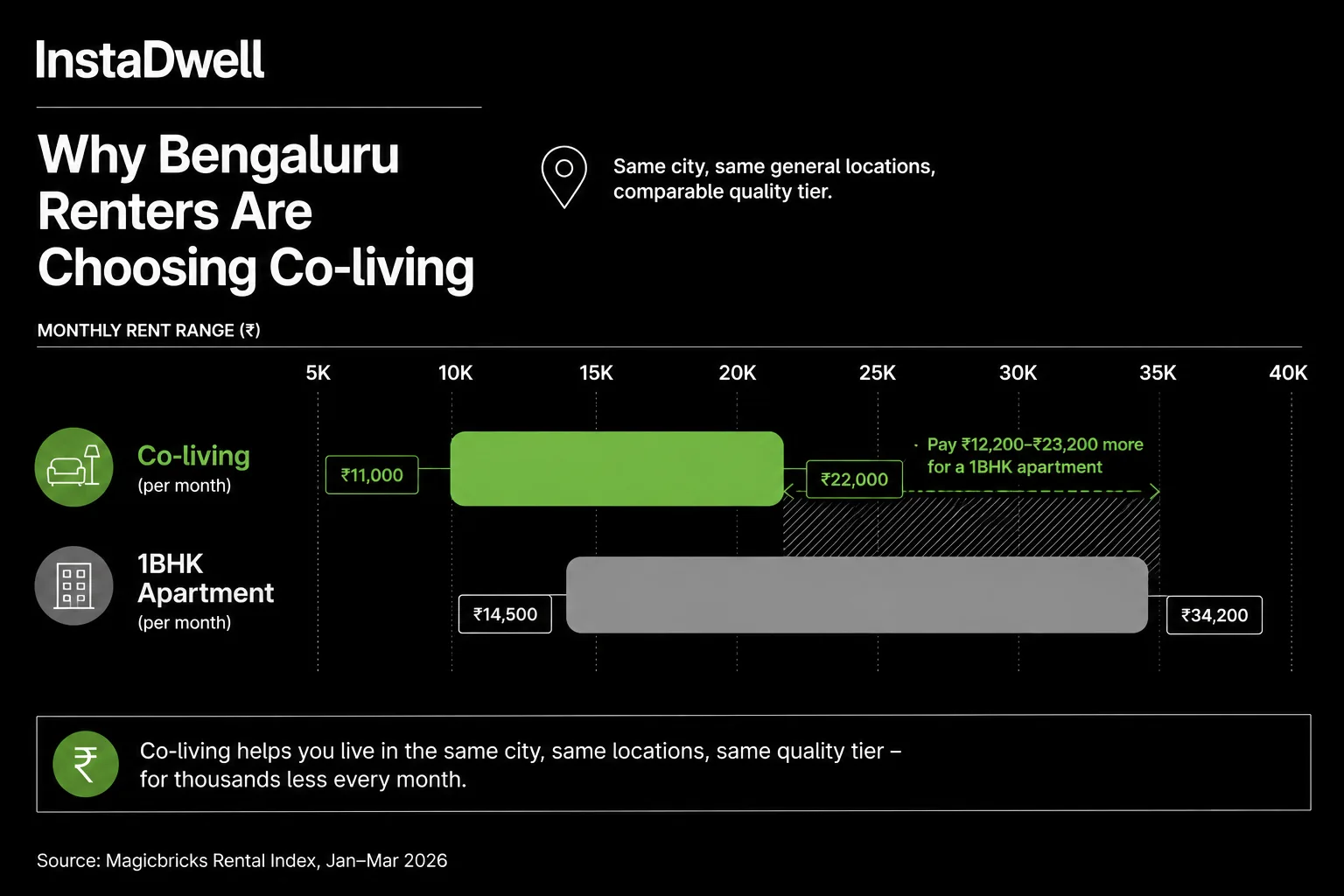
Why Bengaluru renters are choosing co-living over apartments
GCCs are pulling operators into specific Tier 2 cities. Global Capability Centers leased a record 31.3 million square feet nationally in 2025. Most of that activity is still concentrated in six Tier 1 hubs, but a smaller, faster growing wave is opening specifically in Coimbatore, Indore, Jaipur, Ahmedabad, Chandigarh and Nagpur.
Four of those cities already appear in this report’s Tier 2/3 tracker, each with named GCC activity behind it. Bosch and Trimble in Coimbatore, Genpact and MetLife in Jaipur, Impetus Technologies in Indore, and HCLTech’s New Vistas program in Nagpur. Each new center relocates professionals who need housing quickly and have no existing rental network in the city, natural co-living customers.
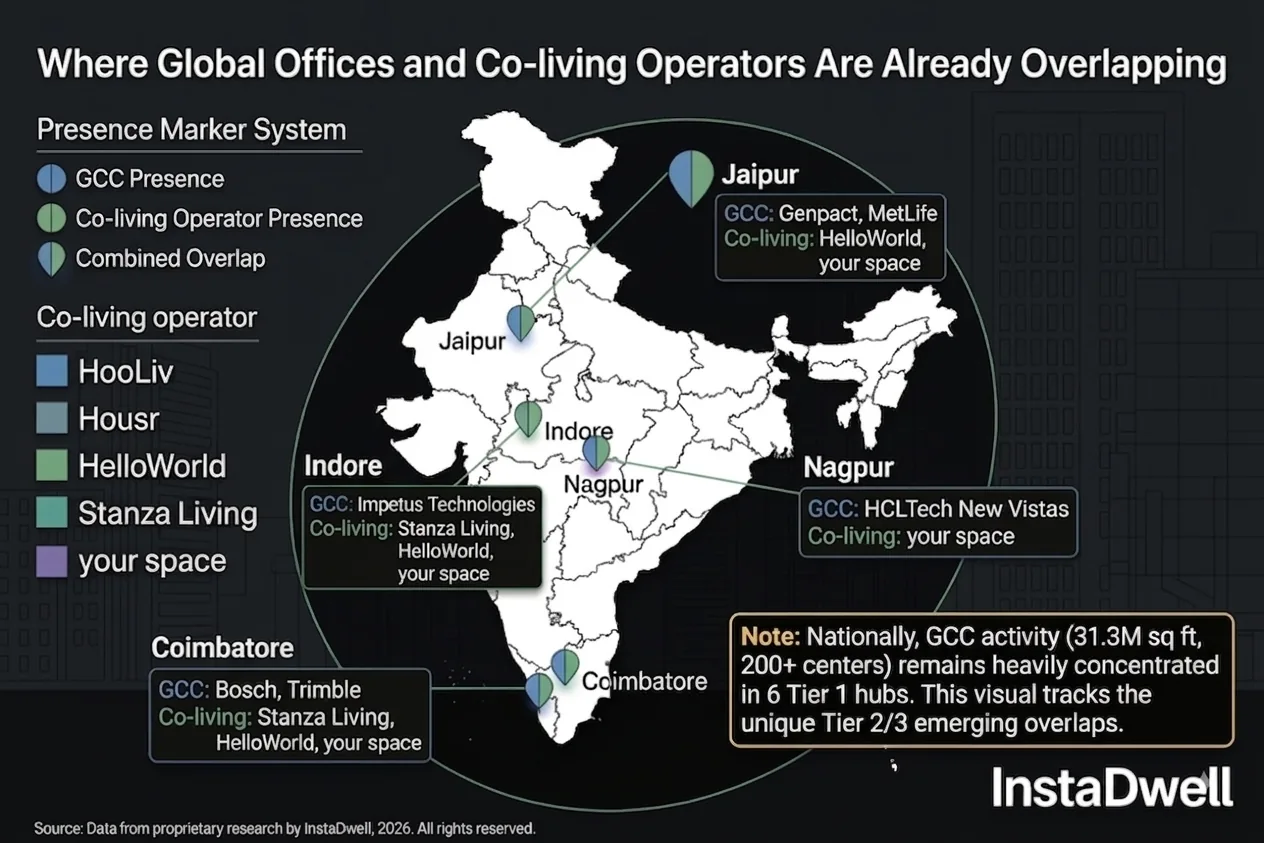
Where global offices and co-living operators are already overlapping
Education demand is structural, and a newer layer is emerging. National higher education enrollment reached 43.3 million students by 2025, more than university owned hostels can house. A newer, smaller driver is a wave of foreign university campuses opening under the UGC’s 2023 regulations, twelve expected to be teaching by September 2026. Mumbai’s Powai corridor, Gurugram, Greater Noida and Bengaluru’s Whitefield are all drawing campuses, feeding the same micro markets organized co-living already targets. This is Tier 1 for now, worth watching rather than a proven driver yet.
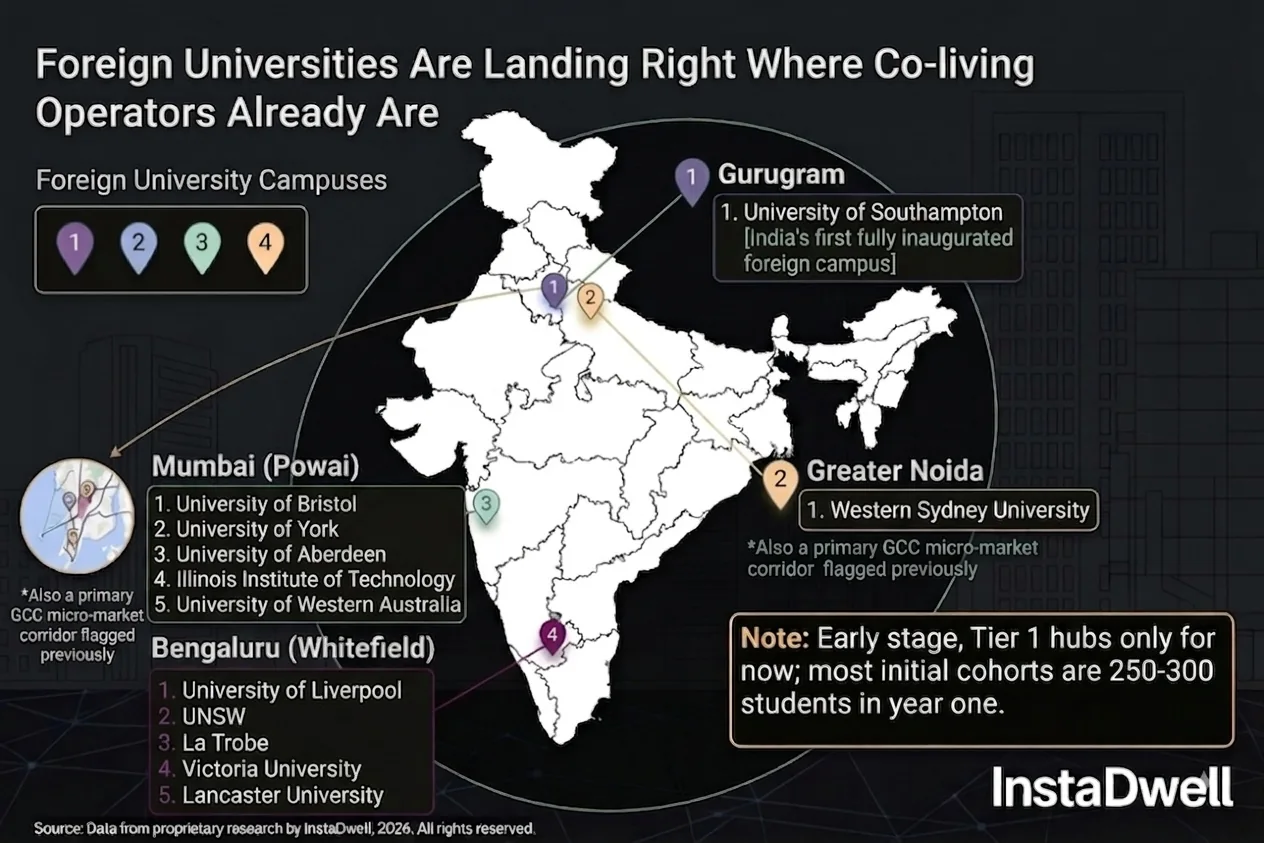
Foreign universities are landing right where co-living operators already are
Institutional capital is validating the model. In September 2025, Bain Capital led a Rs 176 crore Series B for Colive, alongside a Rs 830 crore pan India platform commitment with Sattva Group. In January 2026, HDFC Capital Advisors and Curated Living Solutions launched a Rs 1,000 crore institutional rental housing platform. Two heavyweight investors committing within a four month window is a stronger signal than either move alone.
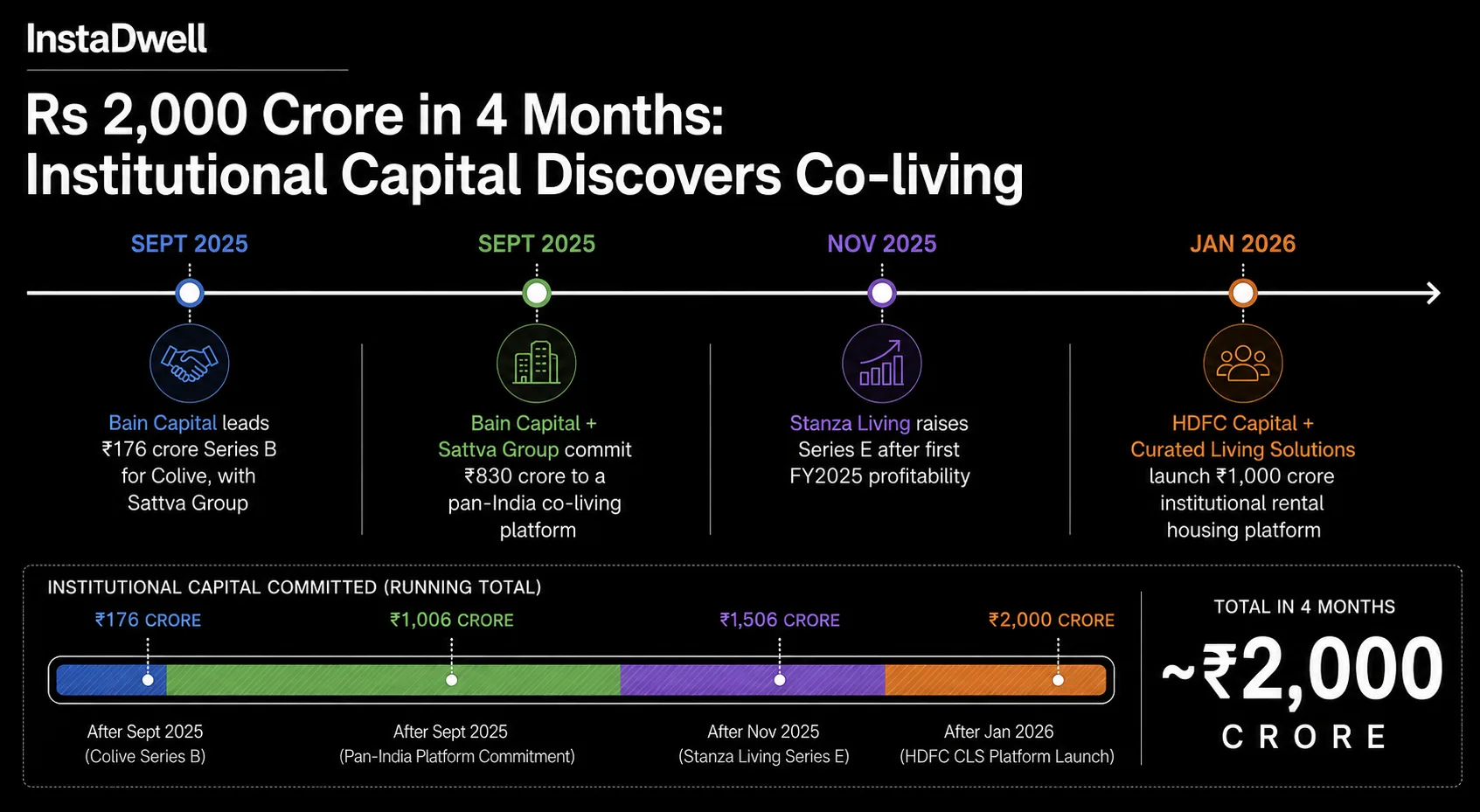
Rs 2,000 crore in 4 months: institutional capital discovers co-living
Restraints
Regulatory fragmentation and leasing costs compress margins. Operators cite standardizing operations across differing state rules as a persistent drag, alongside high leasing costs in prime urban markets. This is one reason the shift toward cheaper Tier 2 and Tier 3 markets is as much a margin strategy as a growth strategy. The Model Tenancy Act of 2021 is seeing wider adoption in 2026, capping security deposits at two months and requiring rental agreement registration, but enforcement remains uneven, illustrated by BBMP’s 2024 action against more than 100 PG properties in Bengaluru for safety violations.
Trust has not been solved even in the industry’s most mature markets. Original research by InstaDwell, based on 61 recorded interviews with active PG and co-living searchers across Bengaluru, Hyderabad, Pune, Mumbai and Delhi NCR between January and June 2026, found the trust gap persists in exactly the markets this report describes as the model being exported into Tier 2 and Tier 3 cities.
Every person interviewed, 61 out of 61, refused to commit financially without a physical visit first, regardless of how polished the booking app was. 58 out of 61 said they do not trust listing photos. 52 out of 61 distrust or are skeptical of Google reviews, describing landlords who withhold deposits until a departing tenant posts a five star review. 37 out of 61 bypass platforms entirely for Reddit threads, WhatsApp groups, or a friend already in the city.
If trust has not been solved where the industry is most mature, there is no structural reason it arrives automatically in Jammu or Raipur simply because a branded operator opens there.
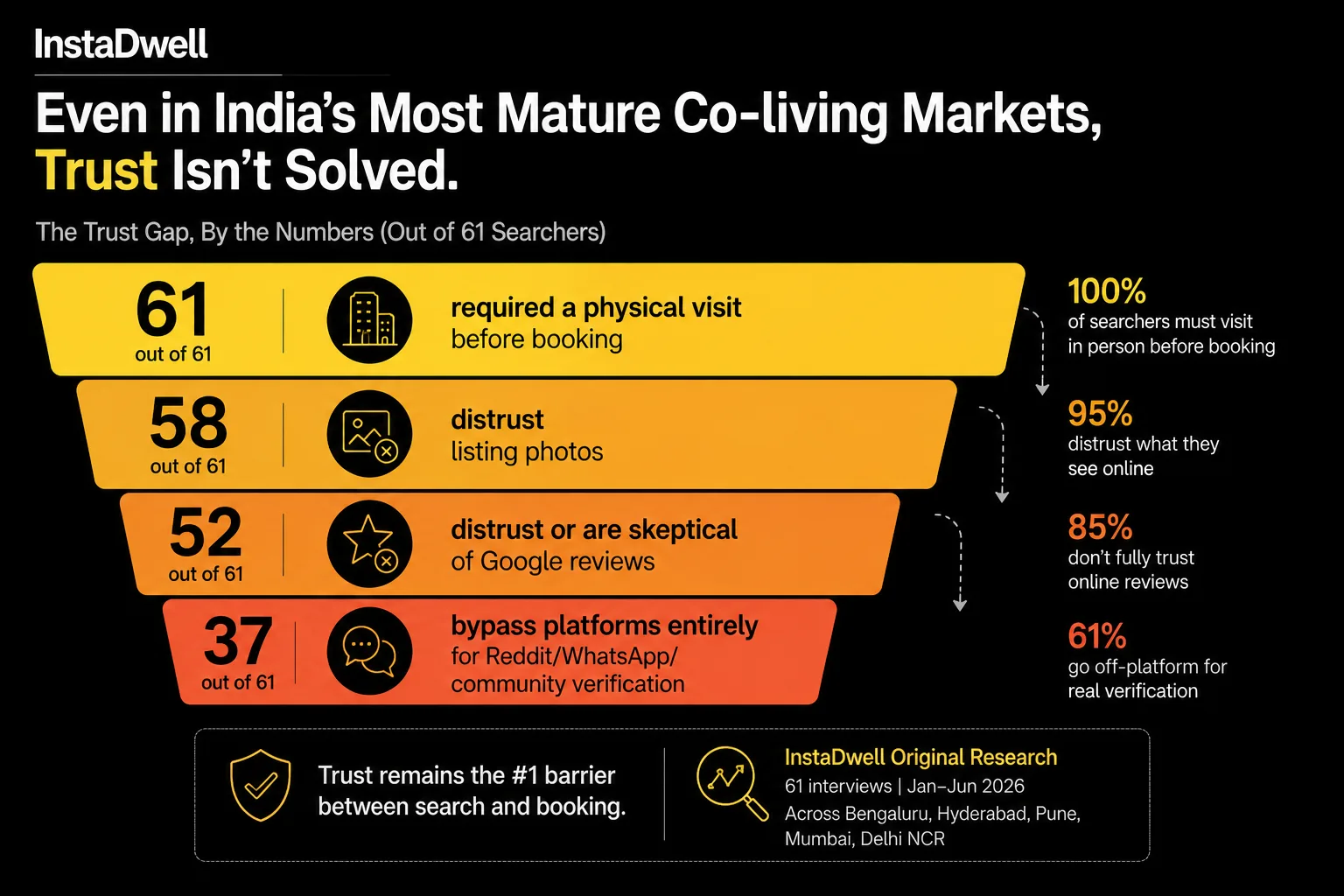
Even in India's most mature co-living markets, trust isn't solved
Market Segmentation
By Geography
Tier 1 absorption is concentrated in specific corridors. Bengaluru holds a 30.4 percent national market share, concentrated around Manyata Tech Park, Whitefield, Koramangala, HSR Layout and Bellandur. It was also the strongest performing rental market nationally in Q1 2026, rents up 8.6 percent quarter on quarter and 12.5 percent year on year. Hyderabad’s absorption is highest in its western corridor, Gachibowli, HITEC City, Madhapur and Kondapur. Pune runs through Hinjawadi, Wakad and Kharadi. Delhi NCR splits between an established core, Gurugram’s Golf Course Road and Sohna Road, and an emerging one, Greater Noida. Mumbai clusters near Juhu, Vile Parle West and Andheri West.
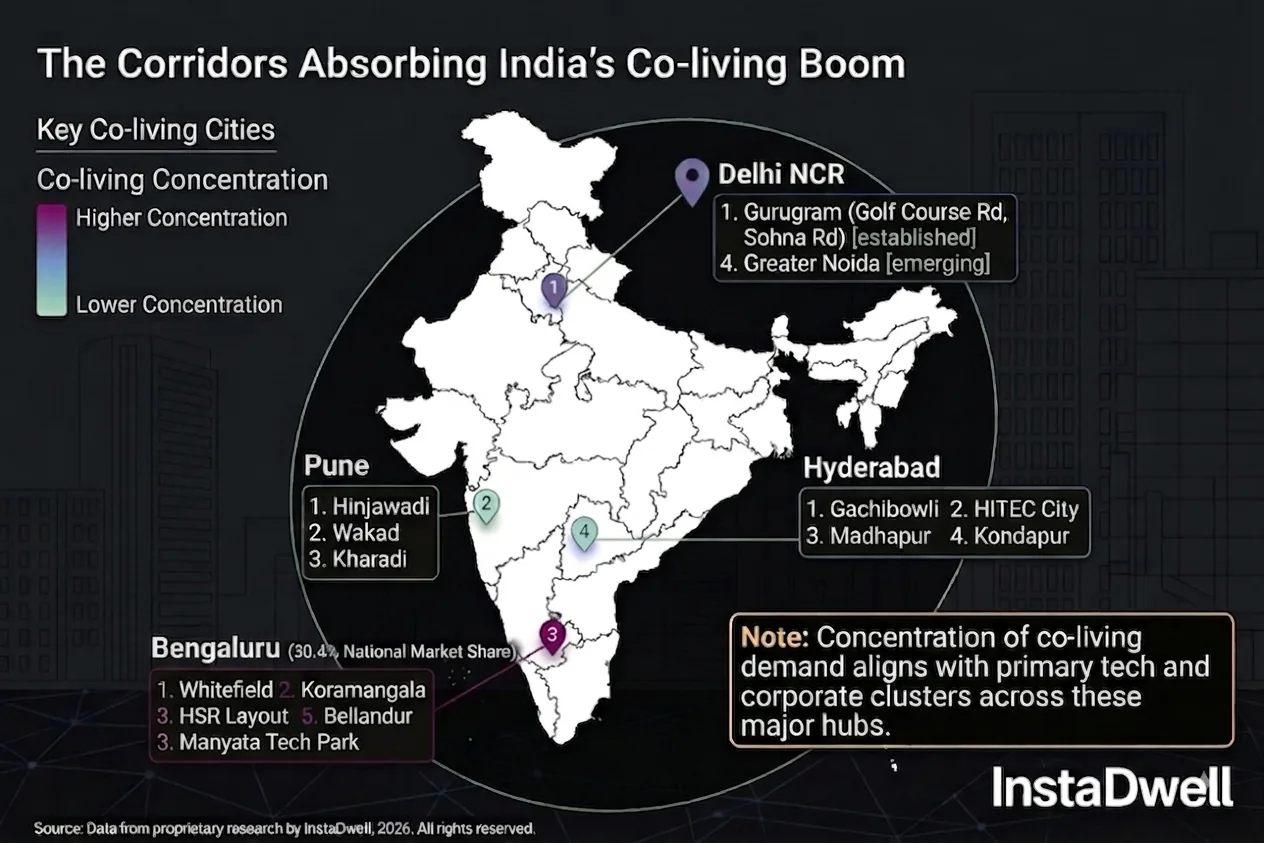
The corridors absorbing India's co-living boom
The Tier 2 and Tier 3 tracker. Organized operators have entered or expanded into these cities largely between late 2025 and mid 2026, drawn by lower acquisition and lease costs than Tier 1 allows.
| City | Operators Present |
|---|---|
| Jammu | HooLiv, institutional tie up established February 2026 |
| Visakhapatnam | Housr, HelloWorld |
| Indore | Stanza Living, HelloWorld, your space |
| Jaipur | HelloWorld, your space |
| Coimbatore | Stanza Living, HelloWorld, your space |
| Dehradun | Stanza Living, your space |
| Kota | HelloWorld |
| Kochi | Stanza Living |
| Vadodara | Stanza Living |
| Manipal | Stanza Living |
| Mangalore | your space |
| Nagpur | your space |
This is, as far as available research shows, the first attempt to compile a single list of which organized operators have entered which Tier 2 and Tier 3 cities and when. A May 2025 Colliers report named a narrower set, Indore, Coimbatore, Chandigarh, Jaipur, Visakhapatnam and Dehradun. This tracker extends that with Jammu, Kota, Kochi, Vadodara, Manipal, Mangalore and Nagpur, current through mid 2026.
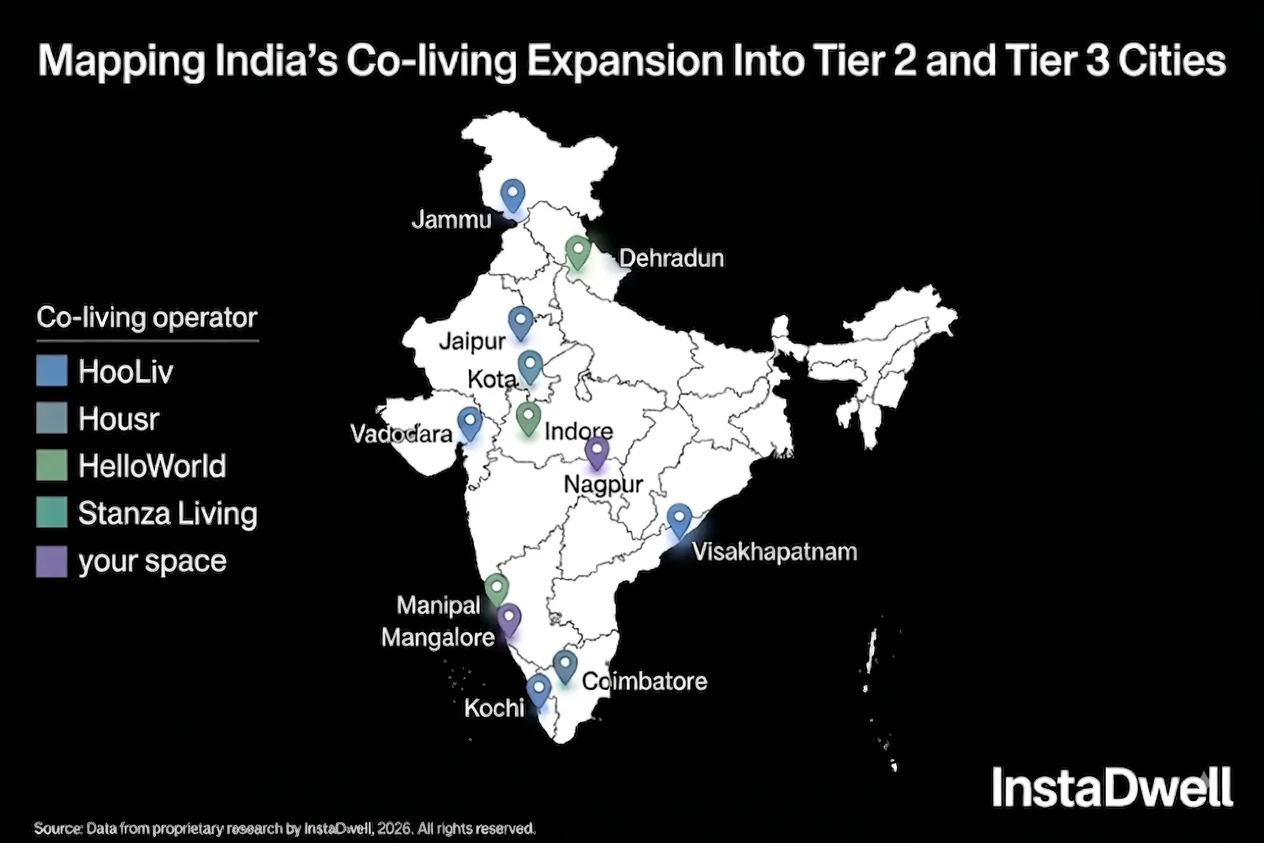
Mapping India's co-living expansion into Tier 2 and Tier 3 cities
Case study, Visakhapatnam. Before 2025, Visakhapatnam’s rental market was dominated by informal PG setups with uneven safety and service quality. Since 2025, Housr has entered targeting Cyber Valley, Rushikonda IT Park and the Madhurawada IT SEZ specifically, while HelloWorld targets the city’s migrant professional base. Visakhapatnam sits inside the Rest of India cluster, projected to grow at 27.19 percent CAGR through 2031, the fastest of any geographic segment nationally.
By Format
Premium formats are emerging alongside budget ones. Atlantis by Student Housing, a girls’ hostel in Mumbai’s Juhu neighborhood next to NMIMS University, lists a gym, jacuzzi, juice bar, doctor visits, and pool and pickleball access among its amenities, priced from Rs 7,50,000 a year, roughly Rs 62,000 to 75,000 a month depending on how the academic year is annualized. The Hive Hostels, another Mumbai operator, lists doctor on call as a standard amenity across properties priced Rs 35,000 to 67,500 a month. This marks a real shift from co-living as a budget dorm alternative toward a higher end managed living product, not an isolated example.
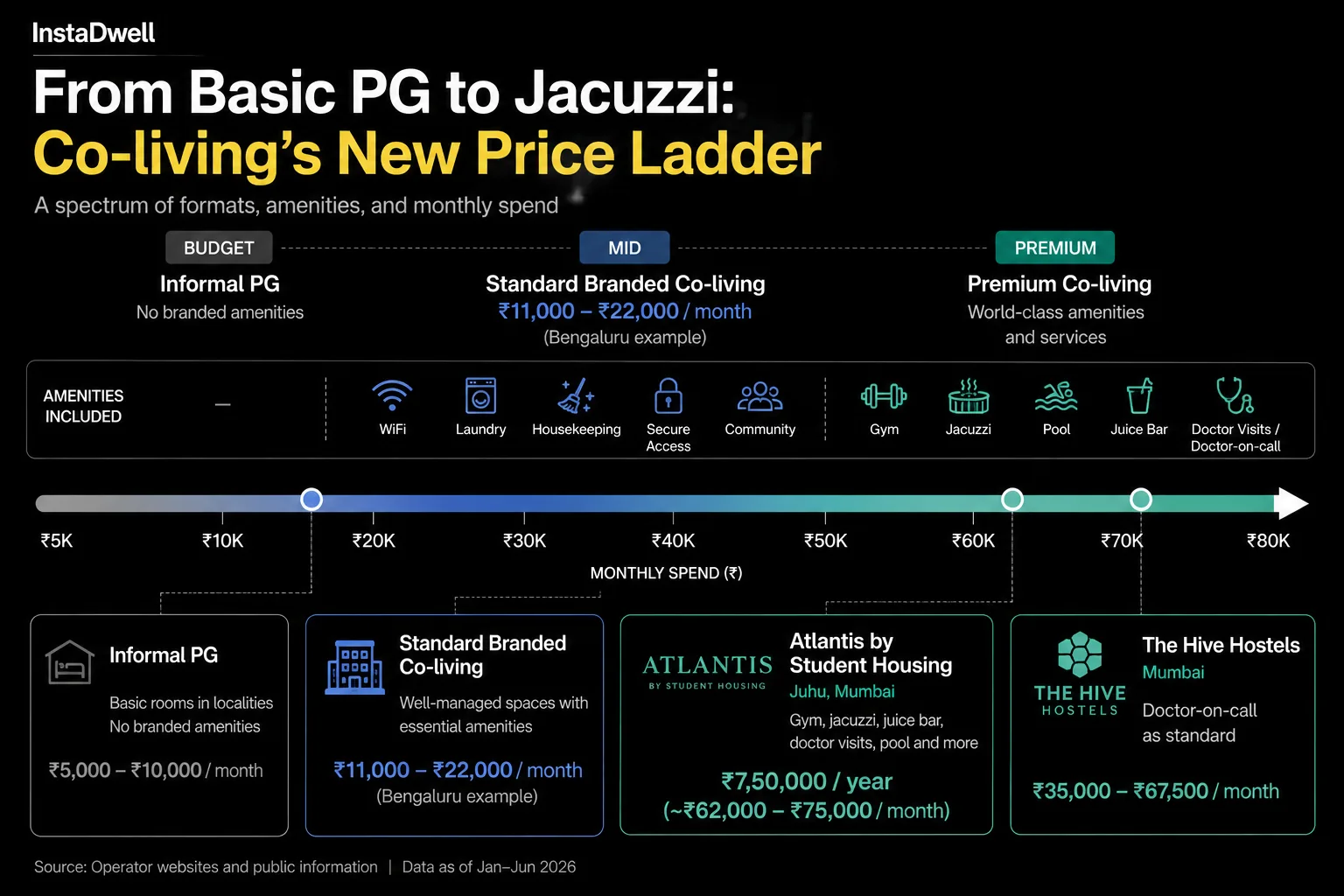
From basic PG to jacuzzi: co-living's new price ladder
Lease terms are segmenting by customer type. Branded operators with strong community programming reported 85 to 90 percent occupancy in 2025. your space requires a 10 to 11 month lock in, matching the academic year for its student base. Housr offers lock ins as short as three months, suited to relocating professionals. HelloWorld sets a minimum lock in designed to reduce uncertainty for both sides.
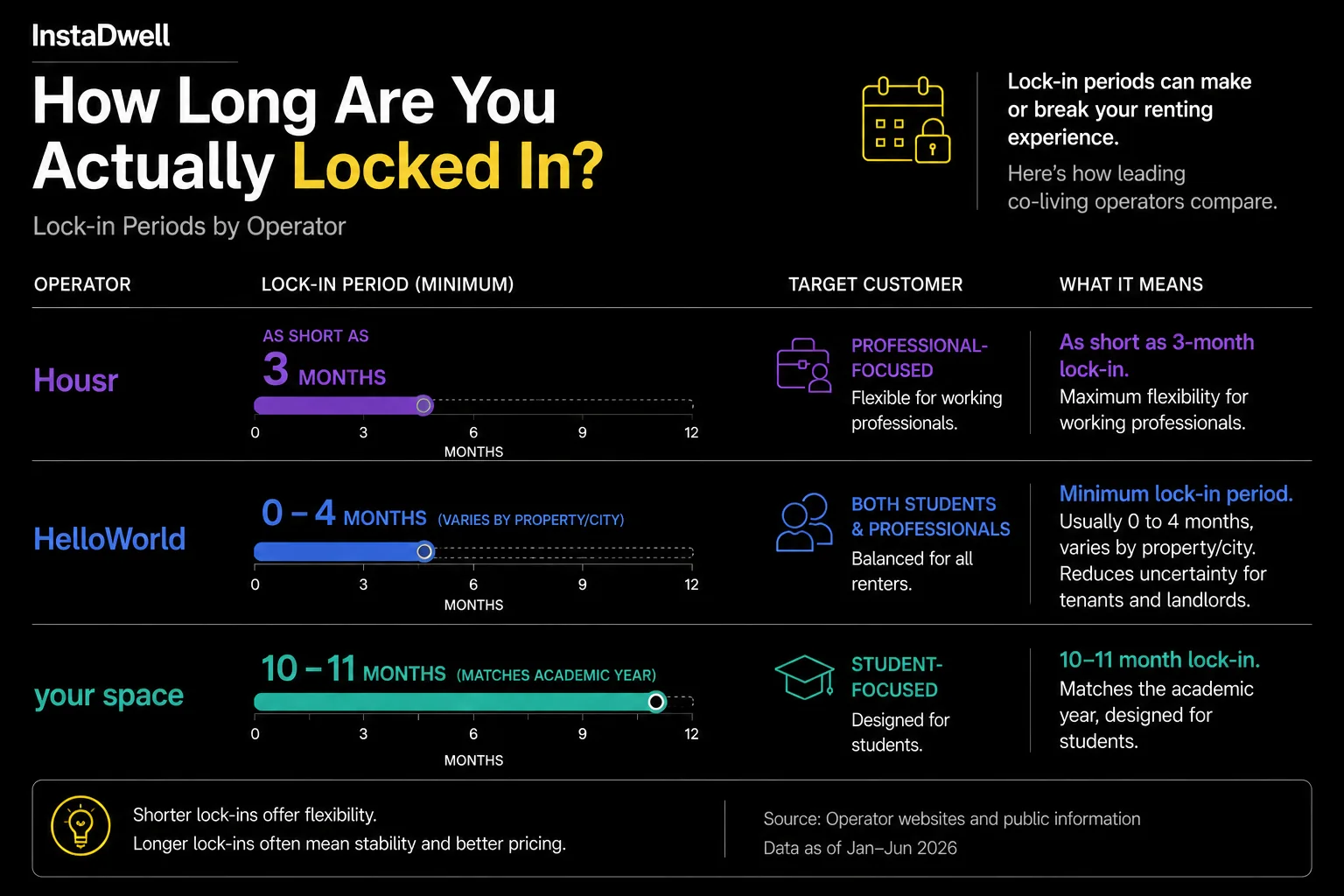
How long are you actually locked in
Underserved formats remain open. Women only supply, industrial worker housing of the kind HDFC Capital’s platform explicitly targets, desk enabled rooms for hybrid workers, and shorter lock in options all represent demand current operators are structurally leaving on the table.
Competitive Landscape
A small number of operators are driving most of the sector’s visible growth.
- HelloWorld, founder and CEO Jitendra Jagadev has described an aggressive growth strategy combining organic expansion with acquisitions, including StayAbode, aimed at reaching 50,000 beds from a current base of 20,000.
- Stanza Living operates more than 50,000 beds across 350 plus residences, reached first net profitability in FY2025, and raised a Series E in November 2025.
- The Hosteller raised expansion capital in April 2026, targeting 25,000 beds nationally.
- Colive raised a Rs 176 crore Series B led by Bain Capital in September 2025, alongside a Rs 830 crore pan India platform commitment from Bain Capital and Sattva Group, with land already acquired in Pune and Bengaluru.
- HDFC Capital Advisors and Curated Living Solutions launched a Rs 1,000 crore institutional rental housing platform in January 2026, targeting co-living, student housing and worker accommodation.
- Experion launched VLIV, a dedicated women only co-living format, in August 2025.
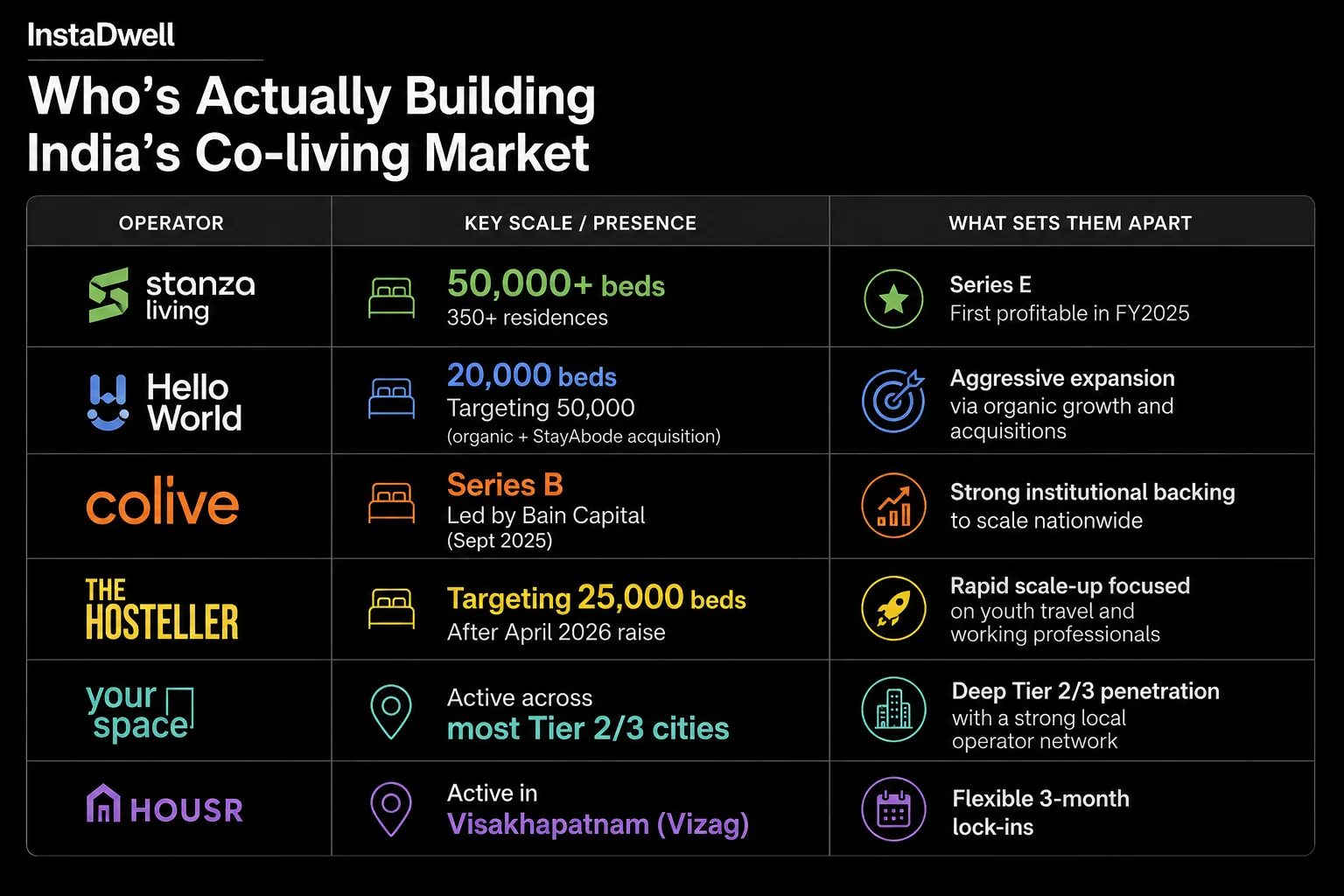
Who's actually building India's co-living market
Read together, this is a consolidation story more than a startup land grab. A small number of well capitalized operators are extending proven models into cheaper, faster growing cities, while new entrant formation slows industry wide, only 5 new startups in the last two years against 36 over five years.
Future Outlook
The Tier 2 GCC pattern points to real next city candidates. Ahmedabad already has a branded operator with live listings, HelloWorld operates there today. Chandigarh and Bhubaneswar do not currently show live listings from the operators earlier reporting had placed there, so that presence could not be confirmed. Combined with Mysuru, which also shows no confirmed branded presence despite its GCC growth, Chandigarh, Bhubaneswar and Mysuru are the more credible next city candidates in this group.
The business model is shifting from leasing to ownership. Bain Capital’s and HDFC Capital’s platforms both point to purpose built, asset backed development replacing the older model of leasing existing buildings. Asset light management agreements scale faster and carry less balance sheet risk than the lease arbitrage most of the sector was built on.
Two demand engines are now running in parallel. GCC driven professional migration and education driven demand, both domestic enrollment and the newer international university layer, are pulling on different customer segments in overlapping geographies. Operators serving both a relocating professional and a student in the same portfolio have a structural advantage.
The underserved segments are the least contested growth space. Women only supply, worker housing, desk enabled rooms and shorter lock ins are not new markets to create, they are existing demand current operators are already failing to serve.
The penetration gap is the single largest number in this report. Organized operators hold roughly 5 percent of a USD 6.3 billion total market. Even a modest increase in that share represents a larger absolute number than most individual growth drivers named above.
Trust is the actual gate on all of it. Capital, city count, and bed targets can all keep growing without penetration increasing, because the physical visit only behavior this report’s own research documented is what caps how fast users convert into organized, digitally booked customers. Whoever solves verified trust at scale is not fixing a complaint, they are removing the ceiling on the 5 percent figure above.
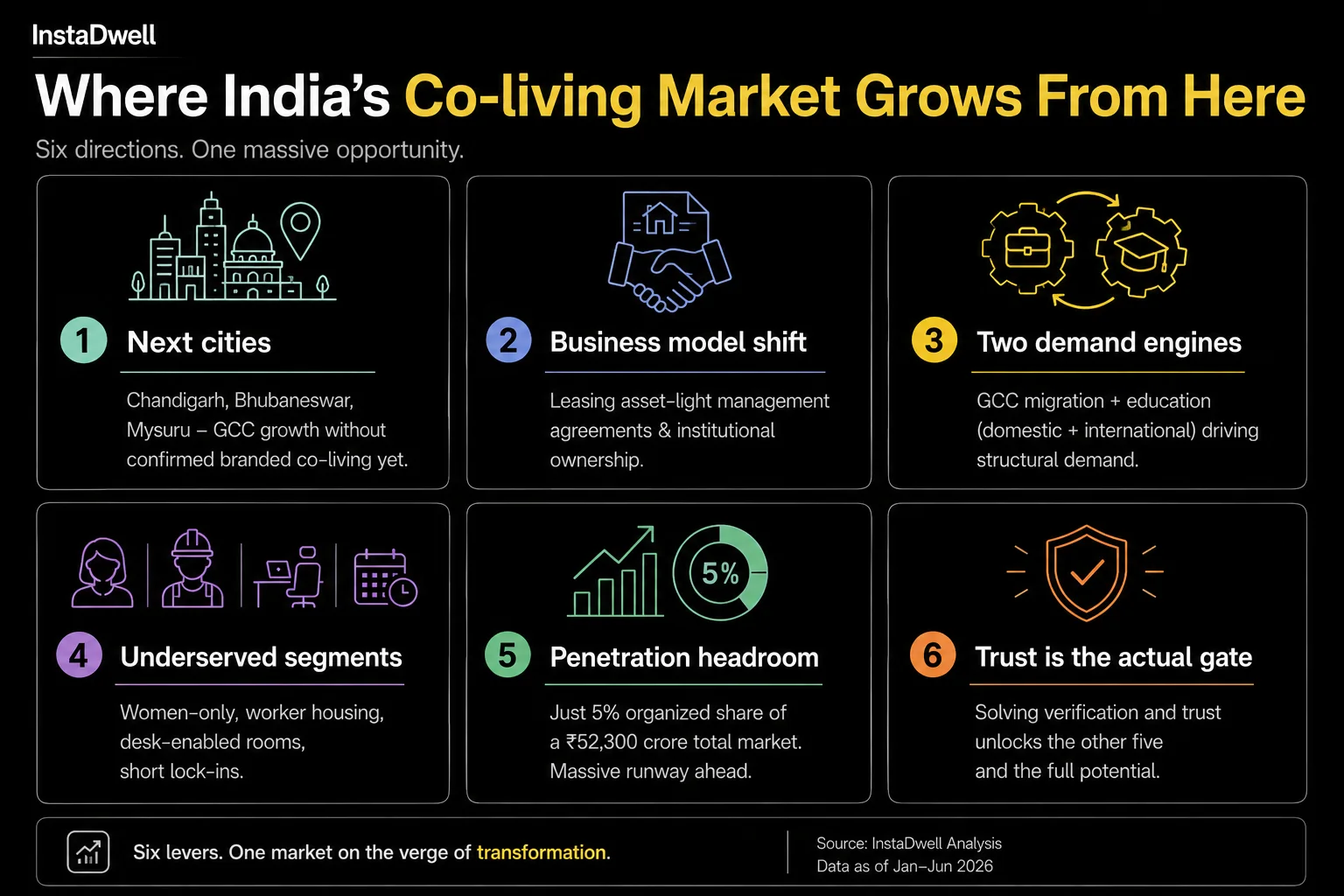
Where India's co-living market grows from here
Methodology and Sources
Market sizing draws on Mordor Intelligence, Colliers and Research and Markets. Competitive and funding data draws on Tracxn. Rent data draws on the Magicbricks Rental Index for the July to September 2025 and January to March 2026 quarters. Trust and search behavior findings are original research by InstaDwell, based on 61 recorded interviews conducted January to June 2026.
INR figures are stated first with approximate USD equivalents in brackets, converted at approximately Rs 83 to the US dollar, rounded for readability.
The Tier 2/3 tracker reflects the cities and operators identified in available sources as of mid 2026 and should be read as a first compilation, not an exhaustive census. Operator presence for Chandigarh and Bhubaneswar could not be confirmed on the operators’ own live listings and is treated as unconfirmed throughout this report.
Source List
Market Sizing
- Mordor Intelligence, India Co-Living Market: https://www.mordorintelligence.com/industry-reports/india-co-living-market
- Colliers India: https://www.colliers.com/en-in/news/press-release-coliving-segment-in-india
- Research and Markets, India Stay Market Sizing and Landscape: https://www.researchandmarkets.com/reports/5319463/india-stay-market-sizing-and-landscape
- Tracxn, Co-living India Feed (referenced for company count, funding, and unicorn data, no public link)
Rent Data
- Magicbricks Rental Index: https://property.magicbricks.com/microsite/research-insights/rental-index/index.html
- NoBroker H1 2025 report, via The Realty Today: https://therealtytoday.com/news/market-insights/moderation-in-rental-inflation-seen-in-bengaluru-and-key-metros-nobroker-h1-report/
Funding and Institutional Capital
- HDFC Capital / Curated Living Solutions, Economic Times Realty: https://realty.economictimes.indiatimes.com/news/industry/hdfc-capital-curated-living-solutions-establish-1000-crore-rental-housing-platform/127712279
GCC Presence
- Coimbatore (Trimble, Elgi): https://gccjournal.in/insights/list-of-global-capability-centers-gcc-in-india/
- Jaipur, Indore, Nagpur (Genpact/MetLife, Impetus, HCLTech), each confirmed via the companies’ own sites
International Universities
- University of Bristol, Mumbai: https://www.bristol.ac.uk/news/2026/february/mumbai-campus-launch.html
- University of Southampton, Gurugram, Press Information Bureau: https://www.pib.gov.in/PressReleasePage.aspx?PRID=2145356®=48&lang=2
Proprietary Research
- InstaDwell, PG Mirage report: https://instadwell.com/blog/pg-mirage-india-google-reviews-vs-reality-pg-search-2026
Premium Formats
- Livlit: https://thelivlit.com/
- The Hive Hostels, Mumbai: https://www.thehivehostels.com/pg-listing/mumbai
- Atlantis by Student Housing: https://www.studenthousing.co.in/listing/atlantis-by-student-housing