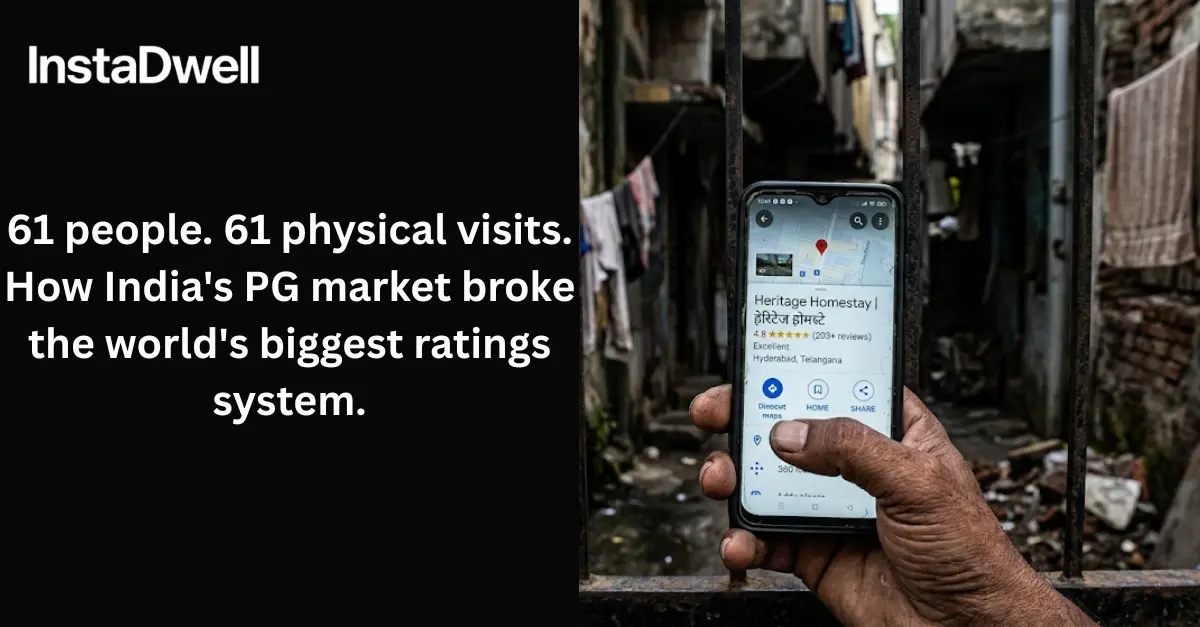
61 people. 61 physical visits. How India's PG market broke the world's biggest ratings system.
Data sources: 61 recorded user interviews conducted by InstaDwell between January and June 2026. Users were actively searching for PG or co-living accommodation across Hyderabad, Bengaluru, Pune, Mumbai, Delhi NCR, and other cities at the time of the interview. All user names have been anonymized to first name only. No operator provided funding or input for this research. Note on methodology: the first set of interviews did not include structured questions on pricing transparency, photo accuracy, or review trust. The figures below reflect only users who raised these issues unprompted or through behaviors that indicated the problem without explicitly naming it. These numbers are undercounts.
The headline numbers
61 out of 61 users we interviewed require a physical visit before making any financial commitment. 58 out of 61 do not trust listing photos. 52 out of 61 distrust or are actively skeptical of Google reviews. 37 out of 61 bypassed platforms entirely for Reddit, WhatsApp, or a friend on the ground.
Those are not edge cases. That is the market.
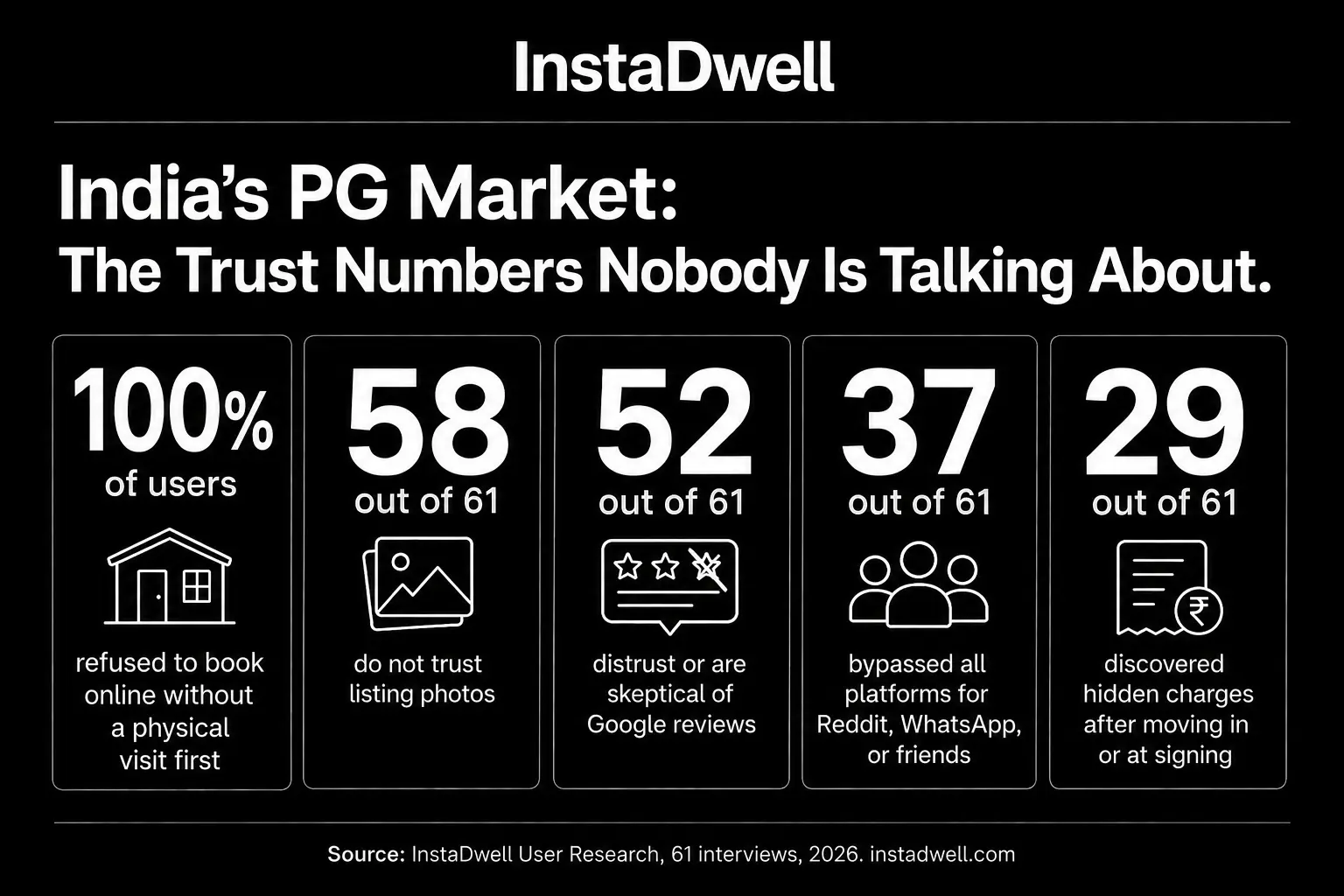
India's PG market: the trust numbers nobody is talking about
Preface: what we expected to find, and what we actually found
When we started talking to users, we expected to hear about a discovery problem. Too many listings, too hard to compare, too much friction in the search. That is the standard pitch for why a platform like InstaDwell needs to exist.
That is not what 61 people told us.
What they described, consistently and without prompting, was something more fundamental. They described a market where every single information touchpoint has been gamed, manipulated, or structurally corrupted. Photos are staged or years out of date. Google reviews are purchased or coerced at the point of deposit refund. Prices displayed online bear no resemblance to the bill at month-end. Amenities listed as private turn out to be shared. And the operators who spent crores building polished apps and seamless booking flows have, in the process, made it impossible for users to trust anything those apps show them.
The result is not a discovery problem. It is a trust collapse. And the industry’s response, more listings, better UI, faster booking, is making it worse.
Who we spoke to
61 users. All actively searching at the time of the interview.
The majority are young working professionals relocating for jobs or internships, with a smaller share of students. Hyderabad accounts for the largest share of searches, followed by Bengaluru, Pune, Delhi NCR, and Mumbai.
Budget clusters: the majority searching in the Rs. 15,000 to Rs. 25,000 per month range for a single or comfortable double sharing room. A smaller group searching below Rs. 12,000 for basic sharing. Outliers in Mumbai reaching Rs. 35,000 to Rs. 40,000.
Gender: approximately 40 to 45 male users, 15 to 20 female users. The female cohort surfaces a completely different, and largely ignored, set of requirements that the industry has systematically failed to address.
Finding 1: the “book online” promise is the industry’s central lie
The entire investment thesis for co-living startups rests on one claim: that housing can be Amazon-ified. Browse, click, pay, move in. Zolo, Stanza Living, and HelloWorld have raised hundreds of crores on the back of this promise.
61 out of 61 users we interviewed require a physical visit before making any financial commitment.
Not most users. Not users in a specific city or budget bracket. Every single person we spoke to, across six cities and a wide range of budgets and demographics, treats the app as a shortlisting tool and their own feet as the booking engine.
Jineet, a UX designer who understands digital interfaces better than most users, still physically walked 10 different properties before signing. He did not trust the apps even though he builds products like them.
The decision journey, reconstructed from the interviews, follows a consistent pattern across cities:
- Search begins on Google and Google Maps, two to four weeks before the move.
- Users move quickly to Reddit (r/Hyderabad, r/Pune, r/Bangalore) for crowdsourced sheets and honest posts.
- They realize that 99acres and MagicBricks are broker traps and stop trusting aggregators.
- They arrive in the city and check into a hotel, a friend’s couch, or a company guesthouse.
- They spend one to three days physically walking the IT corridors and gullies.
- They sign based on what they see, smell, and feel in person.
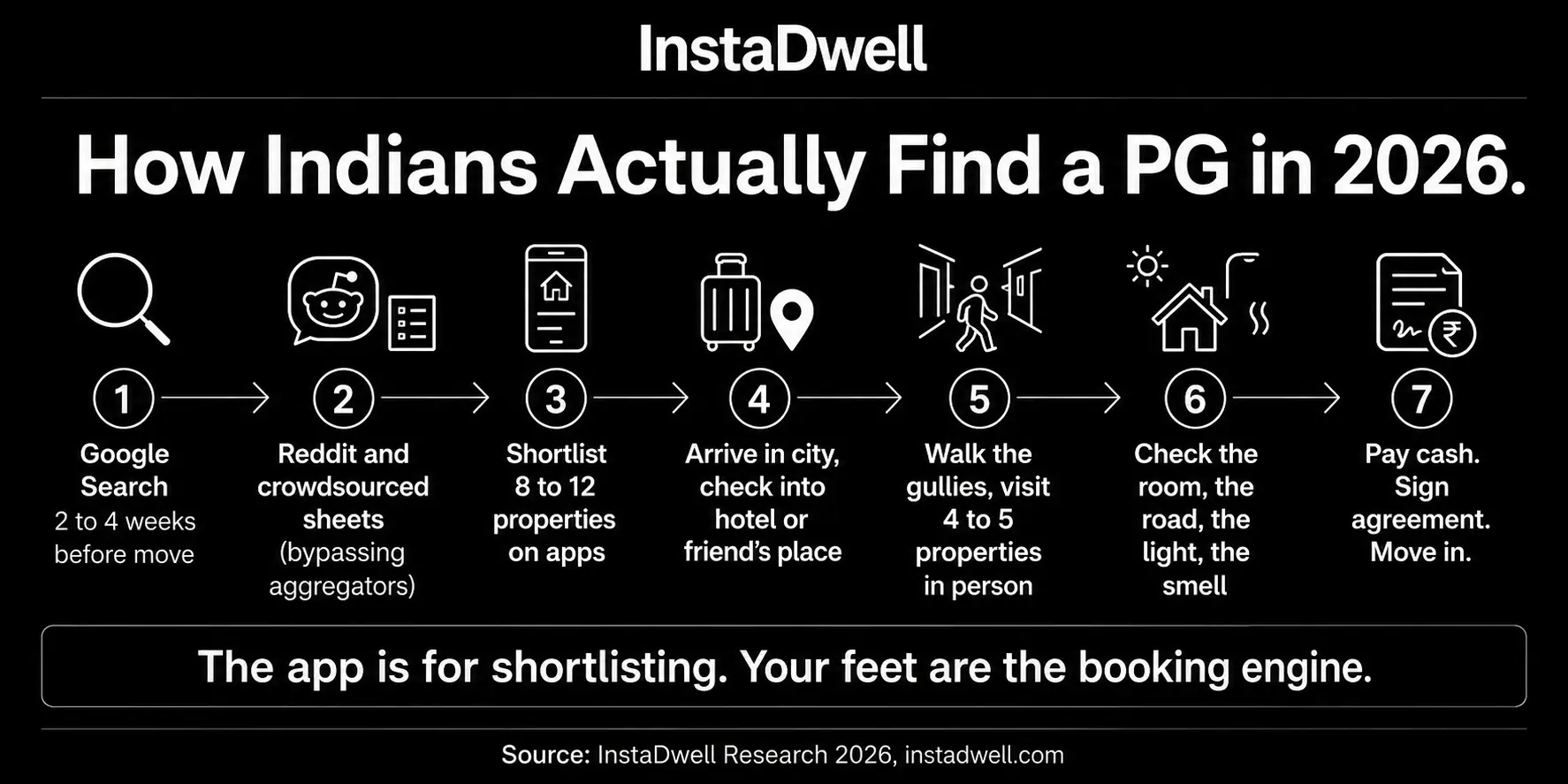
How Indians actually find a PG in 2026: the app is for shortlisting, your feet are the booking engine
The average user physically visits 4.8 properties before making a decision. The average search takes 8 days. Vignesh visited 6 to 7 properties, found all of them unacceptable, and moved into a 1BHK flat instead.
The industry calls this friction to be removed. Users call it the only way to know the truth.
Finding 2: 58 out of 61 users do not trust what they see in listing photos
58 out of 61 users either explicitly stated that listing photos are fake, outdated, or misleading, or demonstrated through their search behavior a complete absence of trust in digital property media.
This is not a complaint about photo quality. It is a structural rejection of the listing photograph as an information source.
“The pictures look very neat and clean, but the actual space is very dusty. Absolutely trashy, and they’re still charging over 13,000 for a place like that.”
- Saahithi, Hyderabad
The deception is specific and consistent. Operators photograph properties at launch, when spaces are freshly painted, empty, and well-lit. Three to five years later, rooms are cramped, maintenance has declined, and natural light has been blocked by new construction. The photos remain unchanged.
“The photos we see online are 3 to 5 years old. And when you actually visit, the property is deep inside some gully you never expected.”
- Nachiketa, Noida
The bait-and-switch extends beyond age and condition to the specific unit shown.
“I was shown photos of the top-floor property, but I was given the first-floor room. My room does not have any natural light whatsoever.”
- Ashutosh, Faridabad to Bengaluru
“I visited Stanza Living. Online it looked very beautiful and comfortable. But when I went there it felt like a haunted house. It was not good at all.”
- Rithanya, Hyderabad
Users have built their own verification layer in response. Several described cross-referencing property addresses on Google Maps Street View and 3D view to judge the external building condition, the nature of the access road, and the neighborhood environment before even scheduling a visit. Users are using satellite imagery as a trust proxy because the operator’s own photographs cannot be trusted.
Finding 3: 52 out of 61 users distrust or are skeptical of Google reviews
Here is the most counterintuitive finding in this report: a high Google rating on a PG listing is now treated by savvy urban migrants as a warning, not a recommendation.
52 out of 61 users either explicitly distrust Google reviews for PG discovery or treat them with active skepticism. 30 users described the specific mechanics of manipulation. 22 users expressed skepticism without detailing the mechanisms. Only one user stated they trust Google reviews.
“Google I don’t trust, because when we leave the PG, the owner makes us drop a review right in front of them. So not everybody gives honest reviews, you know.”
- Viknesh, Pondicherry to Hyderabad
“There have been people who told me to leave a Google review and then rewarded me for it. So honestly, I just don’t trust those reviews at all.”
- Maansi, Mumbai
The mechanics of review fraud in this market are well understood by users. Operators offer Rs. 500 to Rs. 1,000 rent discounts in exchange for five-star reviews. Deposits are withheld until the departing resident posts a positive review, sometimes with the owner standing in the room watching.
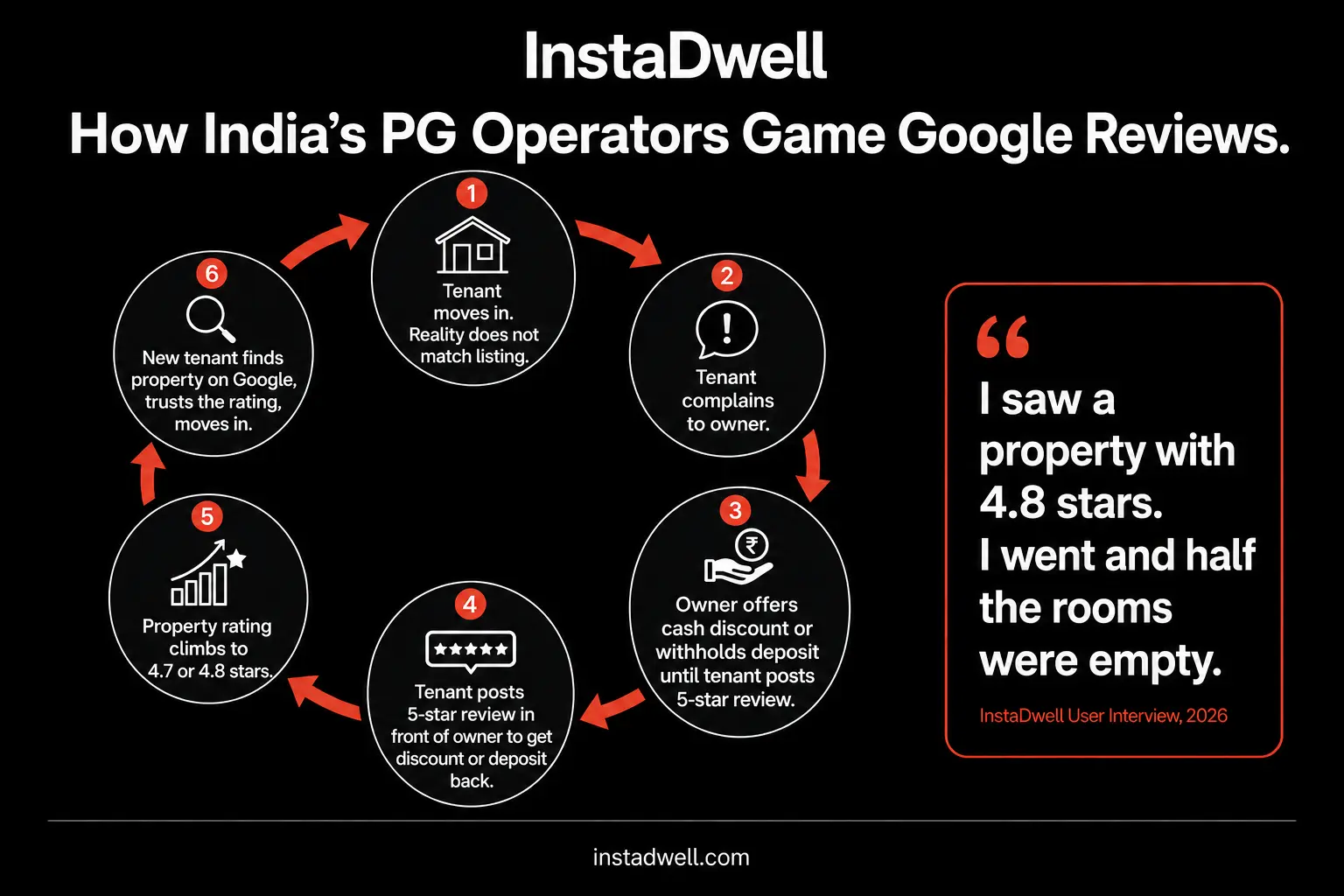
How India's PG operators game Google reviews: the deposit-for-five-stars cycle
Parth described his workaround: “I specifically look at the worst reviews, like videos of rats in kitchens, to find out what is actually wrong.” Savi described only reading the newest and most negative reviews because the positive ones are purchased.
One user, Ashutosh, cited G2, the B2B software review platform, as the model India’s PG market needs, noting that its invoice-based verification process is the only structure that cannot be easily gamed. A SaaS review standard built for enterprise software procurement is now more trusted than a local housing platform. That is the distance between where this market is and where it needs to be.
Finding 4: 37 out of 61 users bypassed platforms entirely for community verification
37 out of 61 users bypassed traditional aggregators and operator apps as their primary source of truth, going instead to Reddit, WhatsApp groups, friends already in the city, office colleagues, or local community networks.
25 users explicitly named Reddit or a community-sourced Google Sheet as their primary discovery channel.
“Before coming to Hyderabad, I posted on Reddit: hey, I’m coming for work, looking for a PG, can anyone share pictures? That was my starting point.”
- Jineet, Pune to Hyderabad, UI/UX Designer
Akshhat described an r/hyderabad thread with 150 to 200 pages of community-sourced listings, complete with direct owner contact numbers and unfiltered resident feedback. Mansi bypassed all platforms for a WhatsApp group where locals shared actual flat and PG availability. Vaibhav had a friend’s relative in Bengaluru find and secure the PG for him.
The reason community verification works where platforms do not is structural. A friend who visits the property has no incentive to mislead. A Reddit thread can be downvoted. None of these channels can be gamed with a Rs. 500 rent discount.
The implication for operators is uncomfortable. The more they invest in brand marketing without fixing the underlying product reality, the more users migrate to channels the brand cannot monitor or influence.
Finding 5: 29 out of 61 users were misled by pricing before or after moving in
29 out of 61 users described being systematically misled by the pricing shown on listings, either discovering additional mandatory charges after moving in, experiencing rent quoted differently in person than online, or carrying ongoing anxiety about what the final monthly outgoing would actually be.
The gap between listed price and actual cost is not marginal.
“When I saw 19,000 I said okay. Then they said water bill is this, electricity bill is this. My budget went up to 25,000. I had to go back to basics.”
- Souvik, Kolkata to Bengaluru
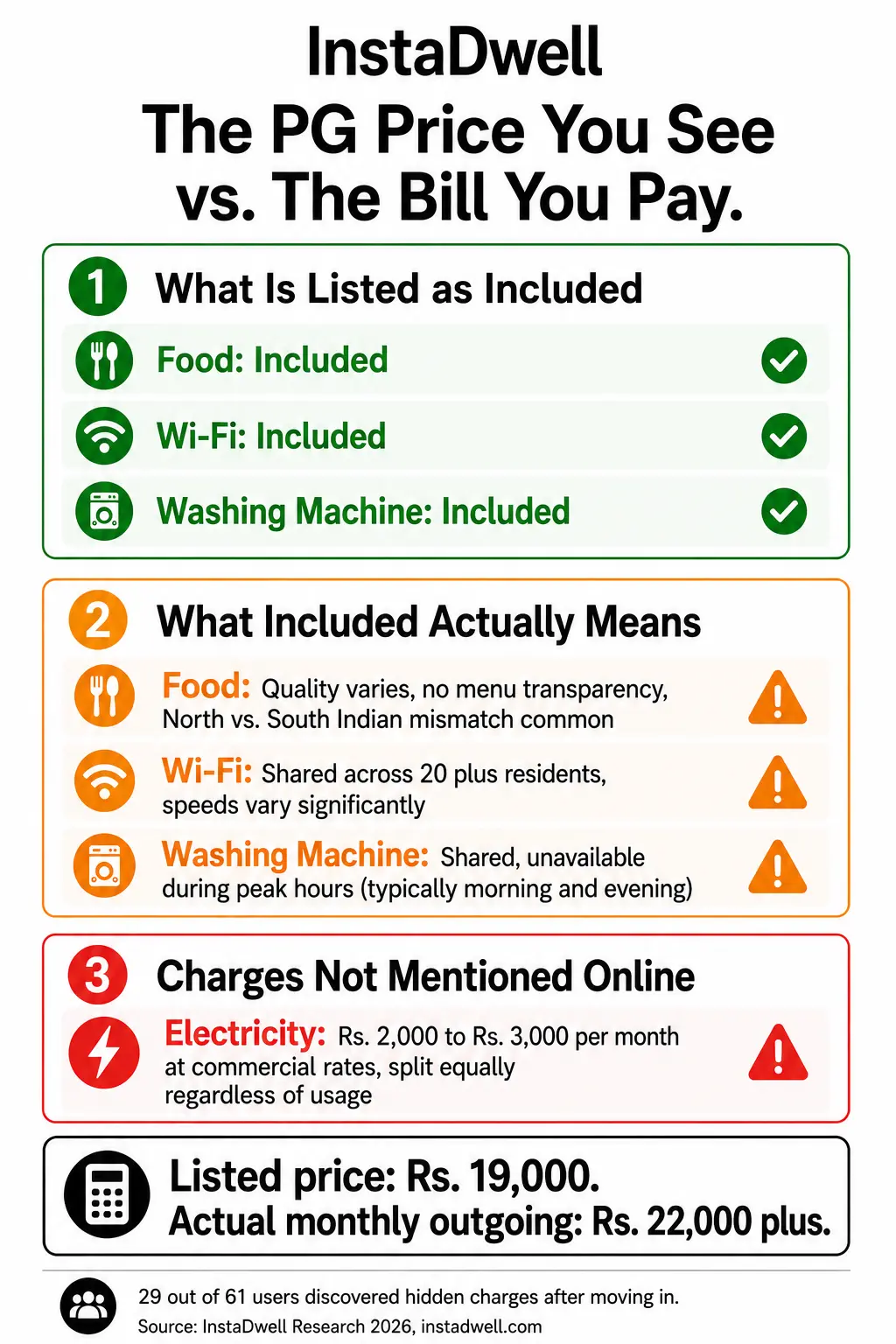
The PG price you see vs. the bill you pay: how a Rs. 19,000 listing becomes a Rs. 22,000-plus monthly outgoing
The pricing gap is not always about utilities. In some cases it is discriminatory.
“My friend was asked for a different amount and I was asked for a different amount, and things changed within one day, based on the face of the customer.”
- Kuneh, Hyderabad
The practice of listing a base price that excludes mandatory costs is not an accident. It is a conversion tactic that depends on the user being too invested in the process by the time the real price is revealed to walk away.
Finding 6: the lock-in clause is quietly destroying the market’s addressable base
The standard lock-in structure across major operators is three to six months. For a large and growing segment of people searching for PGs in India, this is not an inconvenience. It is a complete category exclusion.
“There is no PG that will accommodate you for a month. The minimum stay was six months everywhere. We were looking for just one or two months.”
- Ajith, Mumbai
Ajith discontinued his search entirely and moved in with a friend. The co-living industry did not get his money because its product did not exist in the format he needed. Danch is facing the identical situation, actively working around the PG system entirely.
The lock-in clause was designed to protect operator cash flow and reduce vacancy risk. In practice, it has created a cohort of potential customers who leave the category rather than accept the terms. The industry does not measure this exit because these users never become customers. They remain invisible in the data.
Finding 7: deposits are weaponized twice
Security deposit practices in India’s PG market have created a dual coercion structure. Deposits are used to extract five-star reviews from departing residents and to punish tenants who leave in ways the operator dislikes.
“They put up some drama and try not to give the refund back. The mode of refund is also by cheque, mailed to a residential address.”
- Ricky, Andhra Pradesh to Hyderabad
Ricky also described Colive Garnet’s practice of charging what they call separation charges on exit, deducting ten days of rent from the deposit before returning the remainder.
The refund process is designed to be slow and difficult enough that residents abandon the follow-up. Multiple users described operators refusing to process deposit refunds until the departing resident posts a positive review on Google, sometimes in the owner’s physical presence. The review is extorted, the deposit is returned, and the property’s rating improves.
The most telling data point in this entire report is the coping mechanism users have developed in response.
“I ask for a lower security deposit, like 5,000 or 6,000. If they don’t return it, I treat it as a finding fee, something I am going to lose anyway.”
- Kuneh, Hyderabad
A user has pre-budgeted for the possibility that their security deposit will simply be stolen. This is the trust infrastructure of India’s managed housing market in 2026.
Finding 8: the workspace gap is pushing professionals out of the category
This finding did not emerge from a structured question. It surfaced in multiple interviews unprompted, which makes it more significant than findings we specifically asked about.
The Indian IT workforce is, to a significant degree, working hybrid or fully remote. A PG room that cannot accommodate a desk has become structurally incompatible with the lifestyle of the professional segment that co-living operators most want to attract.
“I searched around 10 PGs. Believe me, 10 PGs, and none of them had a table because the rooms were so congested. As a freelancer, I needed a table.”
- Jineet, Pune to Hyderabad, UI/UX Designer
Operators built their room configurations for a pre-pandemic world where residents went to an office for eight to ten hours and the room was a sleeping and storage space. That world no longer describes a meaningful share of their target users. The result is a segment of professionals who can afford premium PG rents but are taking on the additional complexity and cost of independent flats because a basic professional requirement, five square feet of desk space, is not available in the managed product.
Finding 9: women are being systematically ignored in ways the data cannot fully capture
Female users in our interviews surface a set of requirements so systematically unaddressed by the market that the platforms do not even have the filters needed to surface relevant options.
“One thing I noticed is there were a lot of options for men, but women’s stays were quite limited.”
- Srushti, Mumbai
“My only criteria was female-only. I don’t want co-ed, that is non-negotiable for me. But most places just don’t have that.”
- Vaani, Bengaluru to Pune
The safety requirement for female users goes significantly beyond what any platform currently measures. The relevant metric is not whether the building has CCTV and biometric entry. It is whether the 200-meter walk from the main road at 11 PM is through a lit, populated street or a dark, unpaved gully with no autos. No platform currently captures this.
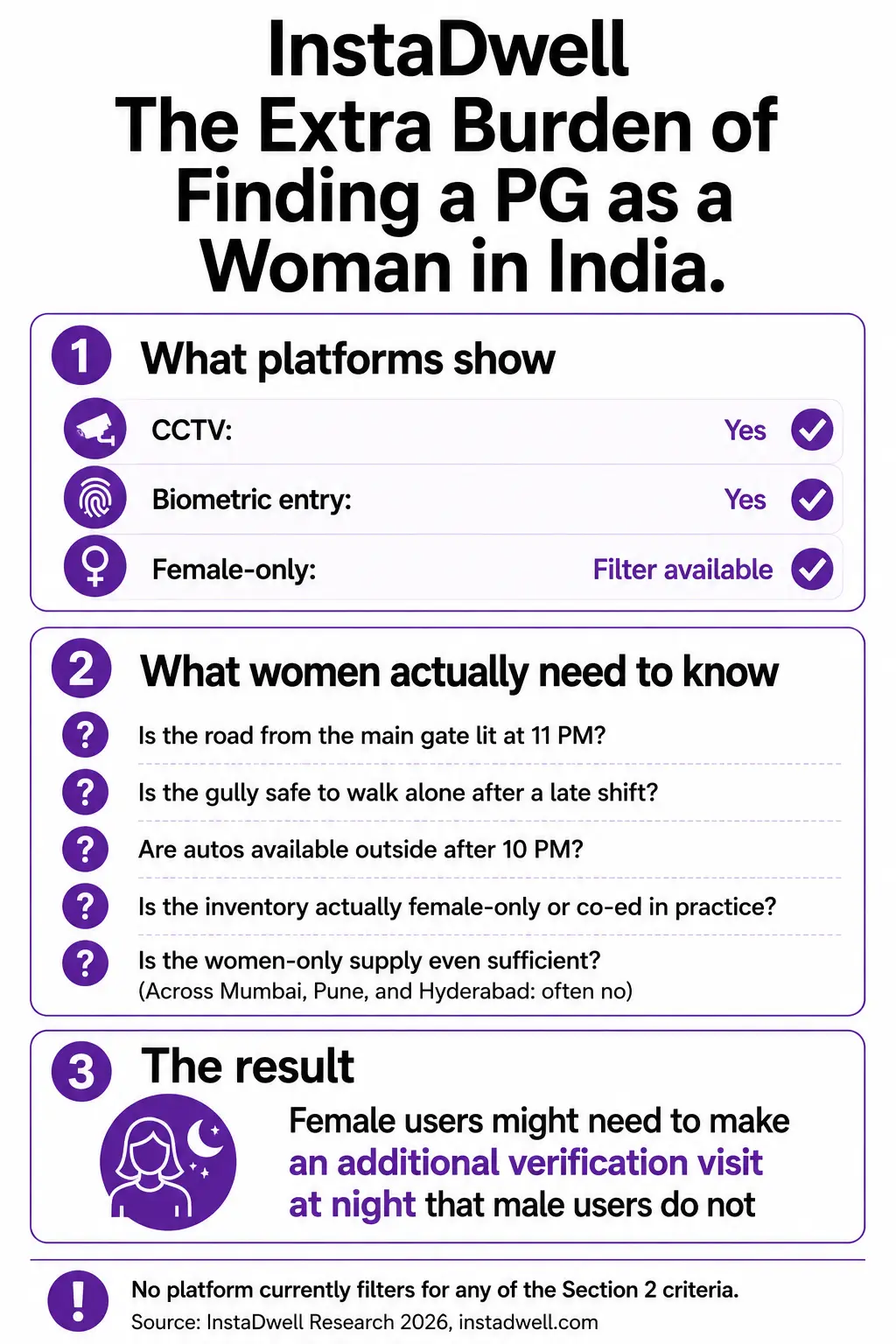
The extra burden of finding a PG as a woman in India: the safety questions no platform answers
Users like Ratana are making this determination by visiting in person at night, an additional verification burden that male users do not face. No male user in our dataset mentioned the women-only inventory shortage unprompted. The gap between what female users need and what the market provides is not visible in the data operators are collecting, because the operators are not asking the right questions.
Finding 10: users are fleeing the category entirely
The most significant finding in this report is not about any specific pain point. It is about what happens at the end of a failed PG search.
Multiple users across our interviews described the same decision: after searching the PG market and finding it unacceptable, they left the category and took on an independent flat instead. This is a more significant statement than it appears. A flat requires a larger security deposit, ongoing bills management, sourcing of furniture and appliances, and coordination of household responsibilities. Users are choosing all of this extra complexity over the “all-inclusive convenience” that PGs market themselves on.
“I went on a PG hunt and had the same horrible experience. The room was so claustrophobic, so small, and they were charging a hefty amount. I just opted for a 1BHK.”
- Viknesh, Pune to Hyderabad
“After seeing all of this, I started looking for a 1BHK semi-furnished flat, because I did not get anything proper in any PG within my budget of 27,000 to 28,000.”
- Vaani, Bengaluru to Pune
The industry’s standard competitive analysis compares Zolo to Stanza, Stanza to HelloWorld. The actual competitive threat is the independently rented flat. And unlike Zolo or Stanza, the flat does not require you to trust a platform or an operator. It requires you to trust a single landlord whose name is on an agreement.
The uncomfortable conclusion
India’s PG and co-living market does not have a technology problem. It has a trust problem so severe that technology is actively making it worse.
Every innovation the industry has introduced, the polished app, the verified listing, the high Google rating, the seamless booking flow, has been absorbed and corrupted into a new mechanism for deceiving users. The response of savvy users is entirely rational: they have stopped trusting digital interfaces and reverted to physical verification, local Reddit threads, WhatsApp contacts, and satellite imagery as their primary research tools.
52 out of 61 users distrust or are skeptical of Google reviews. 58 out of 61 do not trust listing photos. 37 out of 61 bypassed platforms entirely for community verification. 61 out of 61 will not book without a physical visit. These are not edge cases or outliers. This is the market.
The VC pitch for co-living was always about removing friction from a transaction. What 61 users told us is that the friction is not in the transaction. It is in the inability to know whether what is being sold matches what will be delivered. Until the market solves that problem, not with more photos or better UX, but with structural mechanisms for verified truth, users will continue to walk the streets, keep their money in their pockets until they see the room with their own eyes, and treat every star rating as a reason for suspicion rather than confidence.
The co-living market is not being disrupted by a better platform. It is being disrupted by the irreversible loss of user trust. That is the crisis no one in the industry is measuring, because the users who leave the category simply disappear from the data.
Data sources and methodology
| Source | Coverage | What it covers |
|---|---|---|
| InstaDwell user interviews | 61 recorded interviews, Jan to Jun 2026 | Active PG searchers across Hyderabad, Bengaluru, Pune, Mumbai, Delhi NCR |
| Cities covered | 6 Indian cities plus 2 international | Hyderabad, Bengaluru, Pune, Mumbai, Delhi NCR, and outliers in Hong Kong and Nashville |
| Budget range | Rs. 8,000 to Rs. 40,000 per month | Majority in the Rs. 15,000 to Rs. 25,000 range |
| Gender split | Approx. 40 to 45 male, 15 to 20 female | Female cohort analyzed separately for safety and supply findings |
Notes:
- All user names have been anonymized to first name only.
- Figures reflect only users who raised issues unprompted or through observable behavior. These numbers are undercounts.
- No operator provided funding or input for this research.
- Operator names appear based on user-volunteered references in interviews only.
InstaDwell is a co-living and PG discovery platform aggregating verified listings across Indian cities. For press inquiries or to access the underlying data, contact hello@instadwell.com.